
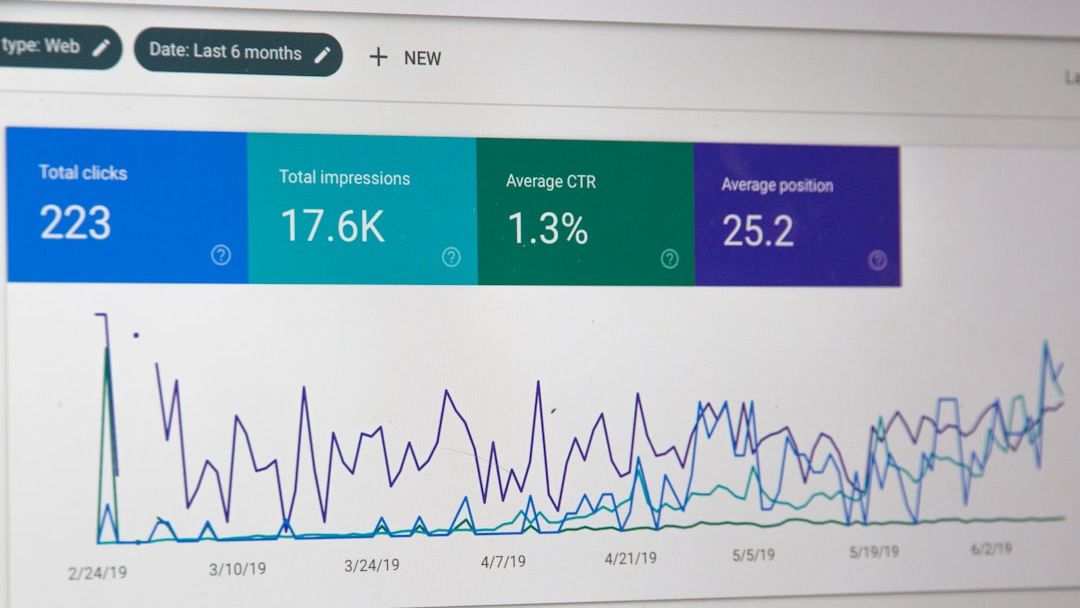
Organic traffic still accounts for over 50% of visits to most websites – yet the majority of French SMEs don't even appear on Google's first page. Here's how to change that, concretely.
What SEO really is (and what it isn't)
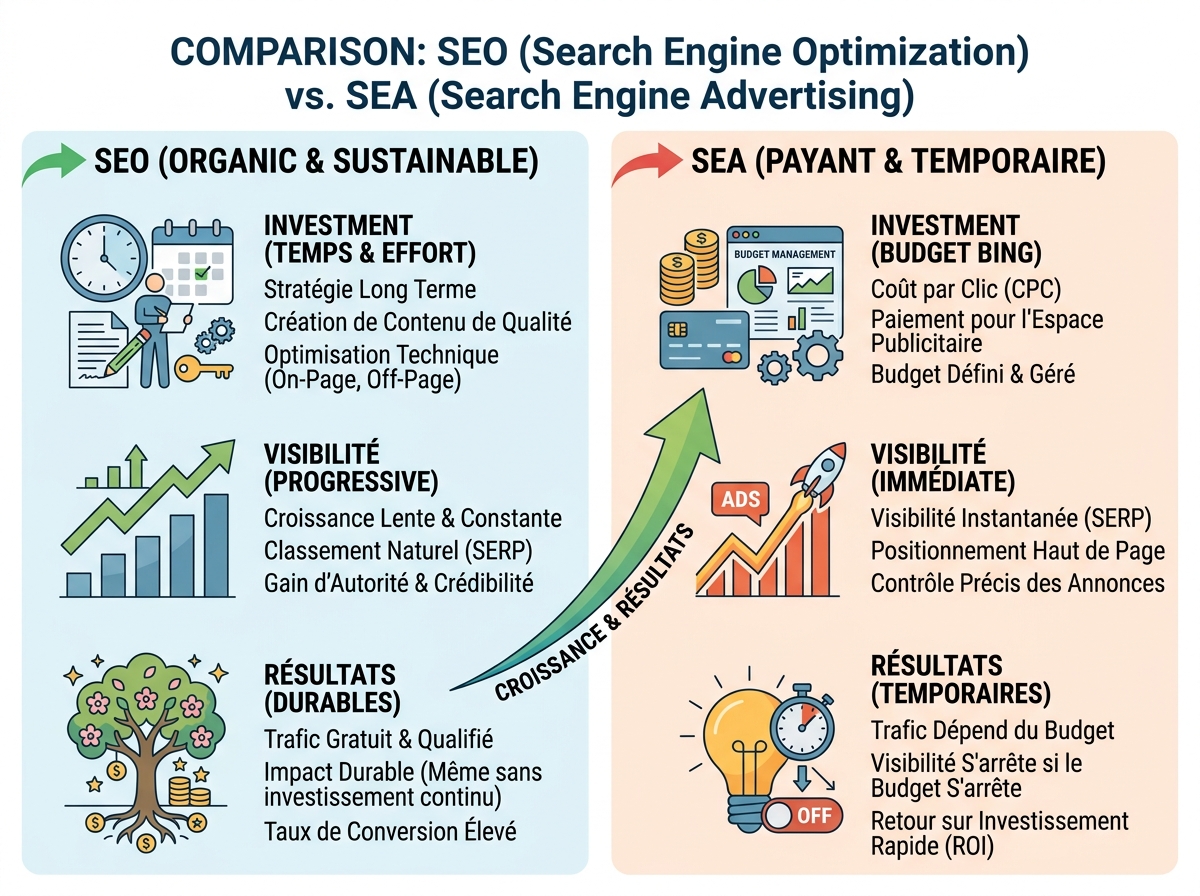
SEO (Search Engine Optimization) refers to all the actions that allow your site to appear in a good position in the natural results of Google and other search engines. It's not magic, nor an advertising expense: it's a structural investment in your long-term visibility.
Unlike SEA (Google Ads), SEO doesn't stop as soon as you cut the budget. A well-positioned article can generate traffic for months, even years. For an SME, it's often the most profitable lever over time.
Not to be confused: optimising for Google in 2026 also means optimising to be cited by generative AIs (ChatGPT, Gemini, Perplexity). These AI engines rely on the same quality signals as Google – authority, relevance, structure – to decide which sources they mention.
Why your site remains invisible despite your efforts
Google's first page captures most clicks. Positions 1 to 3 concentrate the majority of organic traffic for a given query. If your site appears on page 2 or beyond, it is statistically invisible.
But there's a new parameter to consider: Google's AI Overviews (AI summaries at the top of results) now occupy 42% of screen space on desktop and 48% on mobile. Result: the click-through rate for position #1 has dropped by -34.5% since their deployment (source: Blaaaz, 2026). Sites not cited in these snippets lose between 20% and 60% of their informational traffic.
The good news: sites cited in AI Overviews record a +35% CTR compared to their pre-AI performance. Well-executed SEO therefore opens two doors at once.
Technical tags: the foundation Google reads first
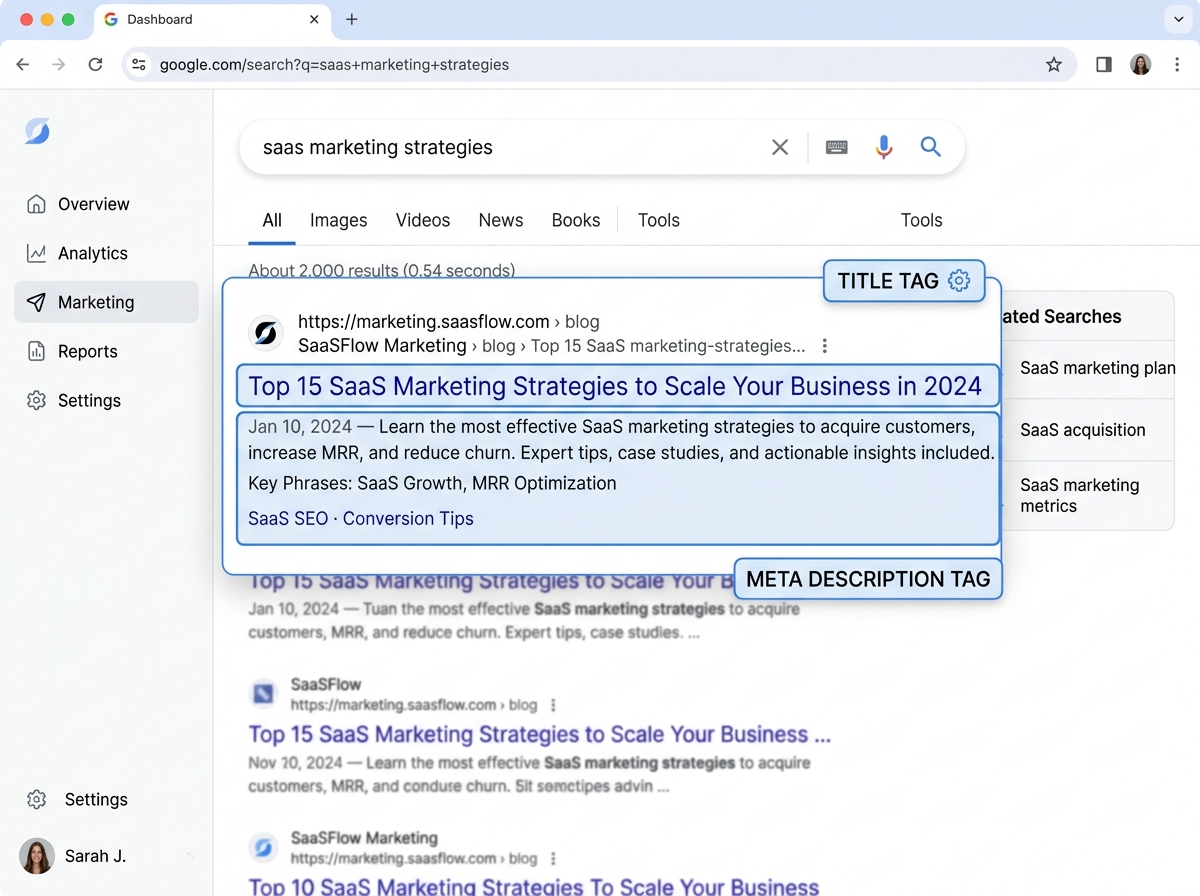
Even before reading your content, Google analyses your tags. Three elements are priorities.
The Title tag is the title displayed in search results. It must contain your main keyword from the first words, remain under 60 characters, and make people want to click. A generic Title tag like "Home – My site" is a missed opportunity with every impression.
The meta description is not a direct ranking factor, but it influences the click-through rate. 155 characters to convince a user to choose your link rather than the competitor's just below. Treat it like a micro-advertising hook.
Hn tags (H1, H2, H3…) structure your page for robots AND for readers. Only one H1 per page, which covers the main topic. H2s divide the main sections; H3s refine them. This hierarchy helps Google understand your content's architecture and facilitates its extraction by generative AIs.
Content and keywords: quality over quantity
Publishing content just to publish is useless. Google evaluates the relevance, depth, and real experience demonstrated in a text – this is what's known as E-E-A-T criteria (Experience, Expertise, Authoritativeness, Trustworthiness).
Concretely, this means:
- Answering the user's question from the first lines (answer-first).
- Including concrete examples, figures, field cases.
- Using secondary keywords naturally, without forced repetition.
- Structuring with lists and subheadings to facilitate quick reading.
An 800-word article that precisely answers a question will consistently outperform a 3,000-word hollow article. In practice, we regularly see SMEs double their organic traffic in six months simply by rewriting their 10 most visited pages with this logic.
To go further on content strategy, the Digitalyser semantic audit identifies exactly the keywords where you have the most to gain.
Speed, mobile, and Core Web Vitals: essential technical criteria
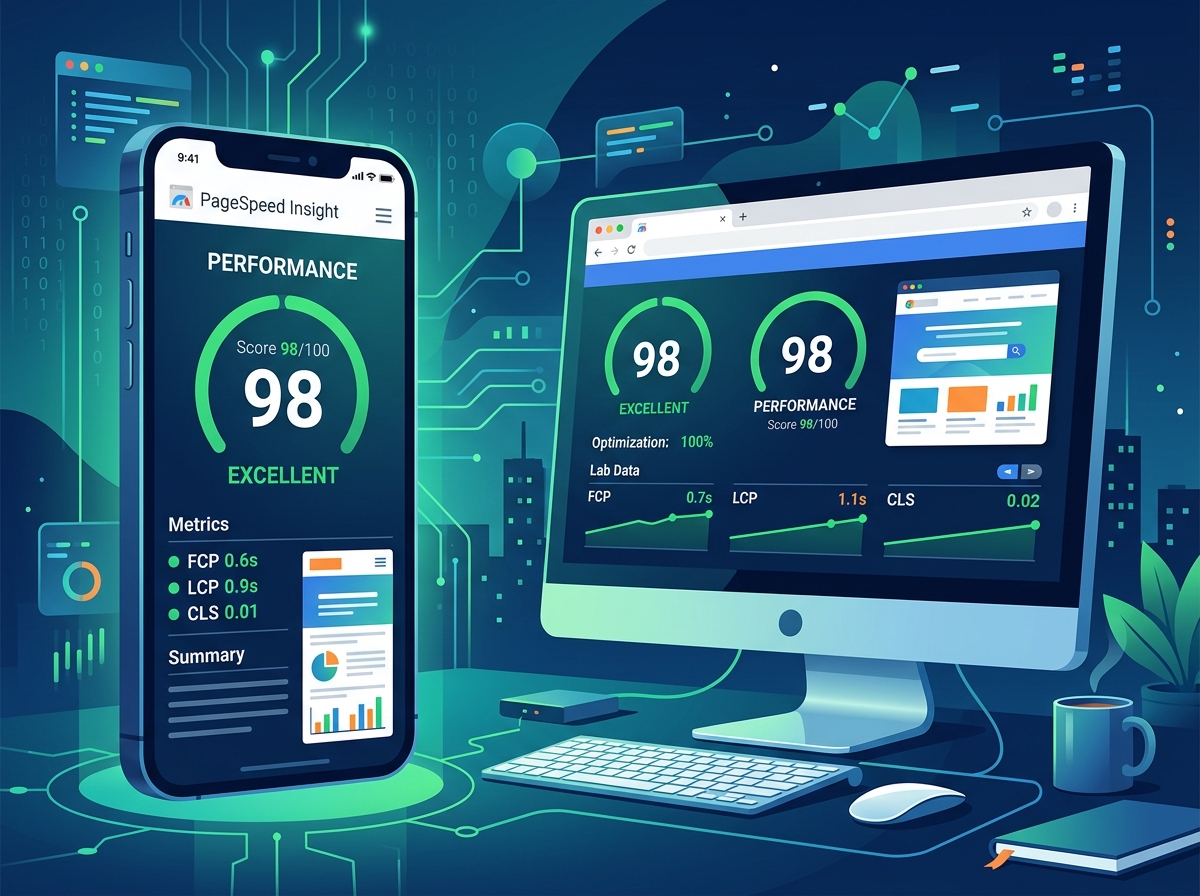
Google has been using loading speed as a ranking factor since 2021, and Core Web Vitals (LCP, INP, CLS) are now official signals. A site that takes more than 3 seconds to load loses an average of 40% of its visitors before they even read a line.
Some concrete levers:
- Compress images (WebP format, appropriate size).
- Enable browser caching.
- Use powerful hosting (avoid low-end shared hosting).
- Remove unnecessary JavaScript scripts.
Mobile is non-negotiable: Google primarily indexes the mobile version of your site (mobile-first indexing). If your site displays poorly on a smartphone, your ranking is directly affected.
Tools like Google Search Console or PageSpeed Insights provide a free diagnosis. But interpreting technical data and prioritising corrections takes time – this is where a technical SEO audit provides immediate value.
Internal linking and backlinks: building authority
Internal linking involves creating links between your own pages. It's free, quick to set up, and often overlooked. Each internal link passes authority from one page to another and helps Google understand your site's structure. Simple rule: every new page published must receive at least one link from an existing page.
Backlinks (inbound links from other sites) remain one of the most powerful trust signals for Google. A link from a recognised site in your sector is infinitely more valuable than ten links from directories without traffic. Quality always trumps quantity.
Some tools like Semrush or Ahrefs allow you to analyse your link profile – but they are designed for expert SEO teams, with subscriptions costing several hundred euros per month. For an SME, the challenge is to identify genuinely accessible link opportunities, not to drown the business owner in complex dashboards. This is precisely what the Digitalyser netlinking and e-reputation offer covers.
SEO and generative AI: the new playing field
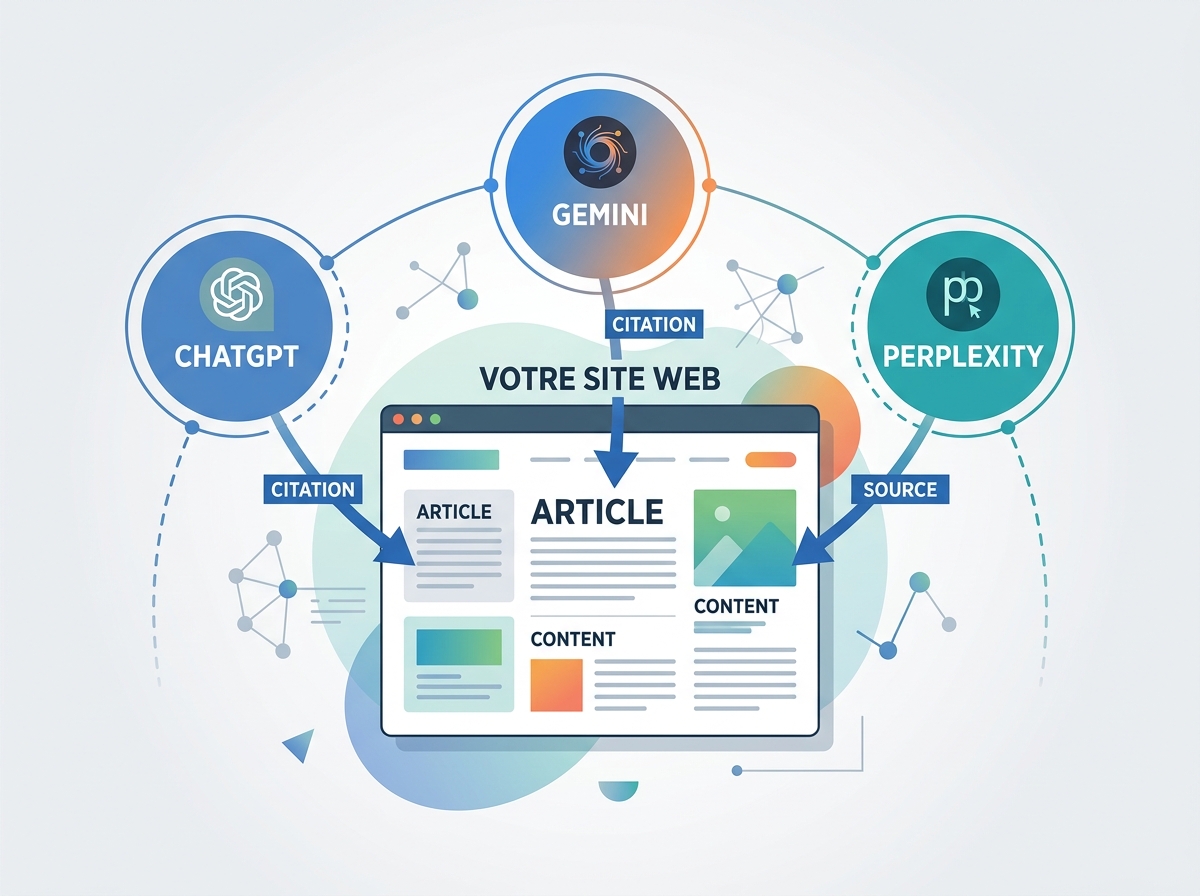
In 2026, optimising your SEO is no longer enough if you ignore AI engines. ChatGPT, Perplexity, Gemini, and Google's AI Overviews draw from the same sources as traditional engines – but with a different logic: they look for trusted entities, structured sources, and directly extractable answers.
To be cited by these AIs, good practices converge with classic SEO:
- Structured content (titles, lists, FAQ).
- Factual data with named sources.
- Consistent web presence (Google Business Profile, brand mentions, reviews).
- Enhanced E-E-A-T signals.
So-called "zero-click" searches (which end without clicking on a site) already account for 60 to 65% of queries (source: Blaaaz, 2026). Being cited in the AI response means existing even without the click – and building brand awareness that then fuels direct conversions.
The Digitalyser 360° visibility audit precisely analyses your SEO positioning AND your presence in AI responses, to identify where you are losing visibility and how to regain it.
Applying SEO basics step by step: where to start?
Faced with the list of possible optimisations, the temptation is to do everything at once – and finish nothing. Here is a proven order of priority:
- Existing audit: identify your already well-positioned pages and those stagnating on page 2.
- On-page optimisation: Title, meta description, H1, content of the 10 strategic pages.
- Technical corrections: speed, mobile, 404 errors, redirects.
- Content strategy: editorial calendar based on high-potential keywords.
- Netlinking: obtain links from partners, local media, quality sectoral directories.
- Monitoring and adjustment: Google Search Console, positions, traffic – measure monthly.
SEO is not a one-off project; it's a continuous process. SMEs that progress fastest are those with a regular pace – even a modest one – rather than those who undertake a major project every two years.
If you want to know exactly where you stand before you start, a free Digitalyser audit gives you a complete diagnosis in a few minutes.