

46% of Google searches have local intent — yet only 35% of French SMEs have a properly optimised Google Business Profile (SMB Marketing Report, 2025). This gap is exactly where your competitors are gaining ground every day.
This operational guide provides you with concrete levers, key figures, and a 90-day roadmap to regain control of your local visibility.
Why local visibility has become a matter of survival
Local SEO is no longer a competitive advantage: it's a prerequisite. According to Semrush (2025), businesses ranked in the top 3 of Google's Local Pack get +126% more traffic and +93% more actions (calls, directions, clicks) compared to positions 4 to 10. In other words, if you're not in that top three, you barely exist.
88% of French people search for a business on Google before any contact (Partoo, 2025). And 76% of internet users who perform a local search physically visit the establishment within 24 hours (Think with Google). This isn't abstract web traffic — it's real customers walking into your shop or calling your switchboard.
The reality on the ground: an SME that doesn't manage its local presence loses customers without even knowing it. They search, don't find you, and go to the competitor who appears just above.
The 5 pillars of a local presence that converts
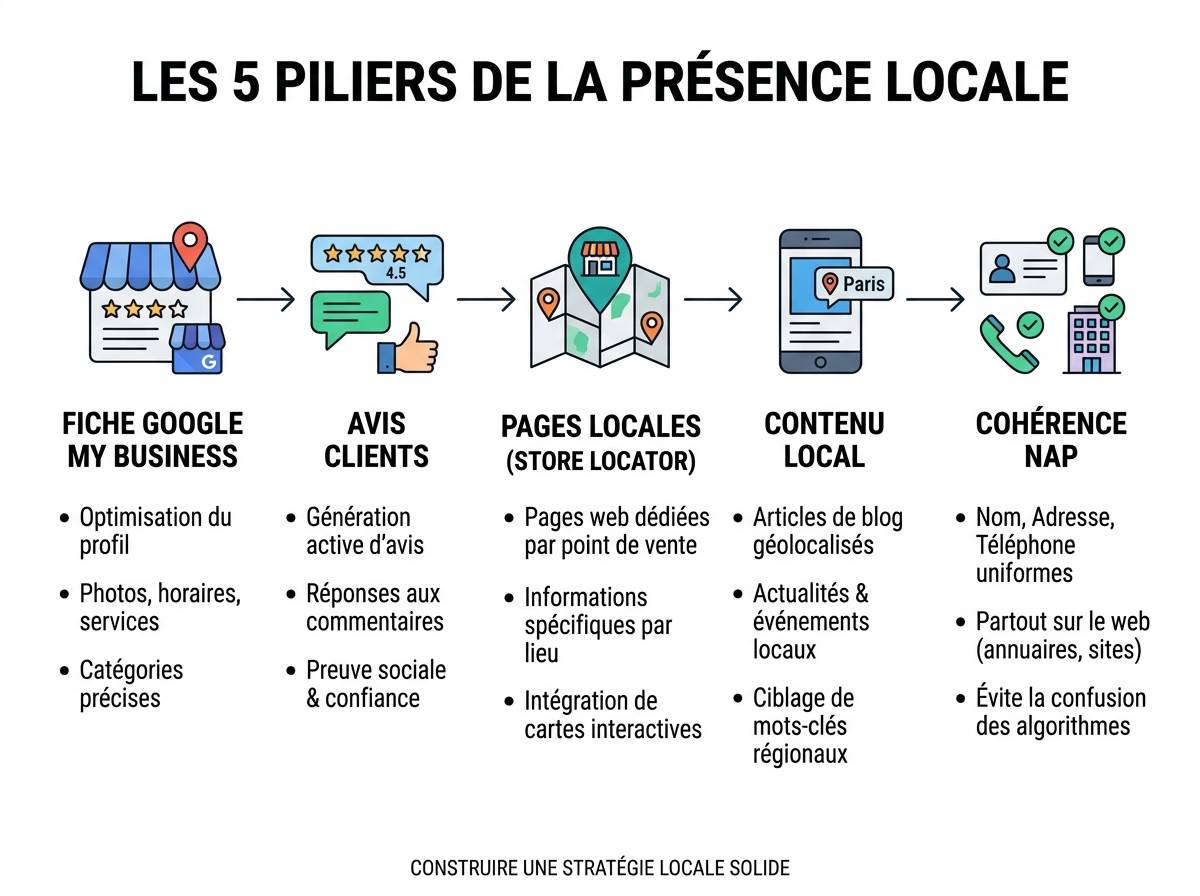
There's no magic recipe, but there is a proven structure. These five pillars form the foundation of any effective local visibility strategy.
1. Google Business Profile: your number one shop window
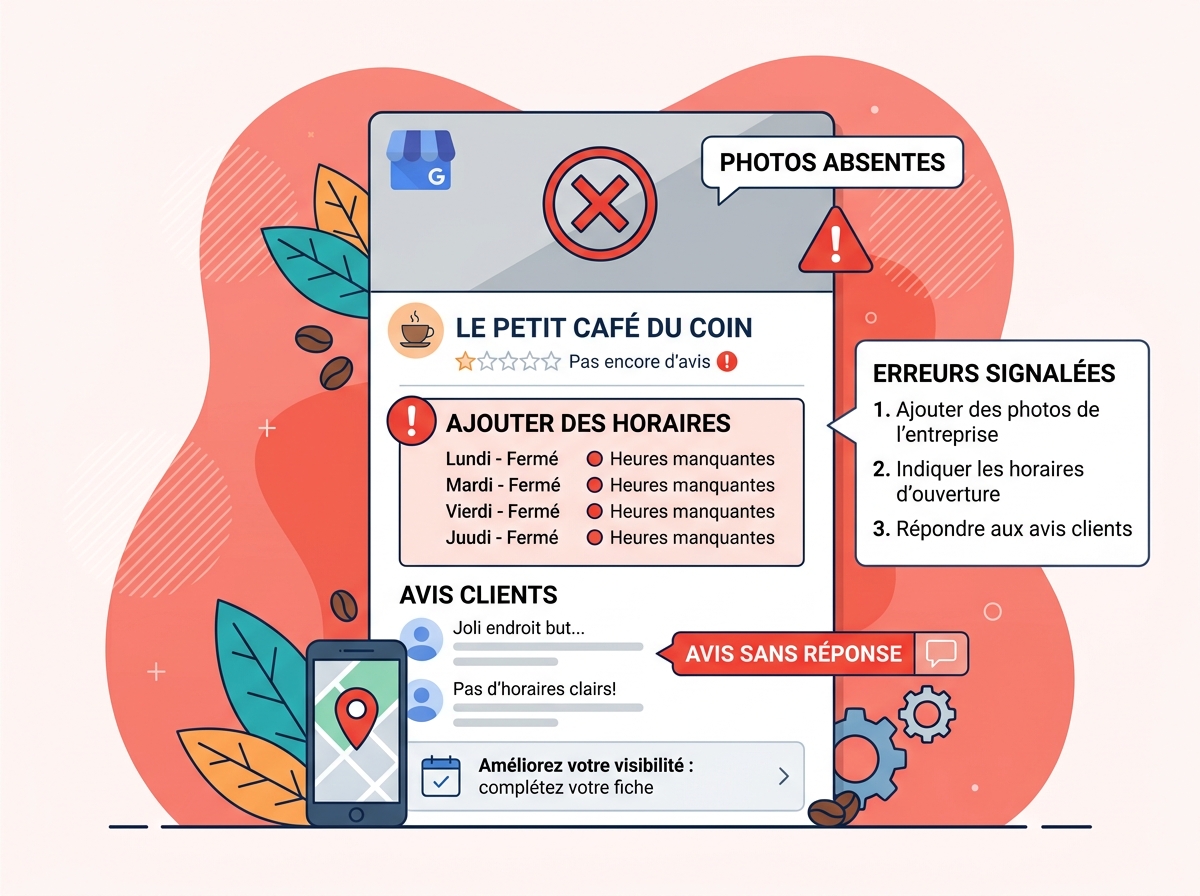
Your GBP listing is often the first contact between you and a potential customer. It must be 100% complete: up-to-date opening hours (including public holidays), precise categories, an optimised description with your local keywords, and recent, high-quality photos. Publish regular posts — at least two per month — to signal to Google that your listing is active.
2. Customer reviews: the fuel of trust
88% of consumers trust online reviews as much as personal recommendations (Forbes, 2026). Going from 3 to 5 stars on Google generates +25% more clicks (Search Engine Land, 2026). The strategy is simple: systematically ask for a review after every successful service, and respond to all of them — positive and negative. Businesses that respond to more than 30% of their reviews generate twice as many leads (Search Engine Land, 2026).
3. Local pages on your website
A well-constructed page like "plumber in Muret" or "hairdresser in Bordeaux Chartrons" can continuously attract qualified traffic. Each page should target a service + geographical area combination, include local testimonials, an integrated Google Maps, and a clear call to action. It's initial work, but the return on investment is long-lasting.
4. Regular local content
Publish articles, news, or advice related to your business AND your local area. An electrician in Lyon can write about new energy renovation standards in the Rhône. A restaurant in Nantes can relay local events. This content anchors your expertise locally and feeds your semantic SEO.
5. NAP consistency across the entire ecosystem
NAP stands for Name, Address, Phone. These three pieces of information must be rigorously identical on Google, Pages Jaunes, Yelp, TripAdvisor, your website, and your social media. An inconsistency — even a minor one — degrades your local ranking. Audit your citations at least twice a year.
What market tools don't tell you
Platforms like BrightLocal or Yext allow you to manage your citations in bulk. Useful, certainly — but designed for experienced marketing teams, with prices that quickly exceed an SME's budget. Partoo is more accessible, but remains focused on listing management, without a global vision of your visibility.
What these tools don't do: they don't cross-reference your local SEO with your online reputation, your presence in sectoral directories, and your ability to be cited by AI agents (ChatGPT, Gemini, Perplexity). However, in 2026, this GEO (Generative Engine Optimization) dimension becomes essential: more and more local searches go through AI assistants that synthesise results — and if your business is not structured as a reliable and coherent entity, you won't exist in these responses.
This is precisely what Digitalyser's 360° visibility audit covers: a complete analysis that goes from local SEO to entity reputation, including the consistency of your structured data.
90-day roadmap: from zero to visible
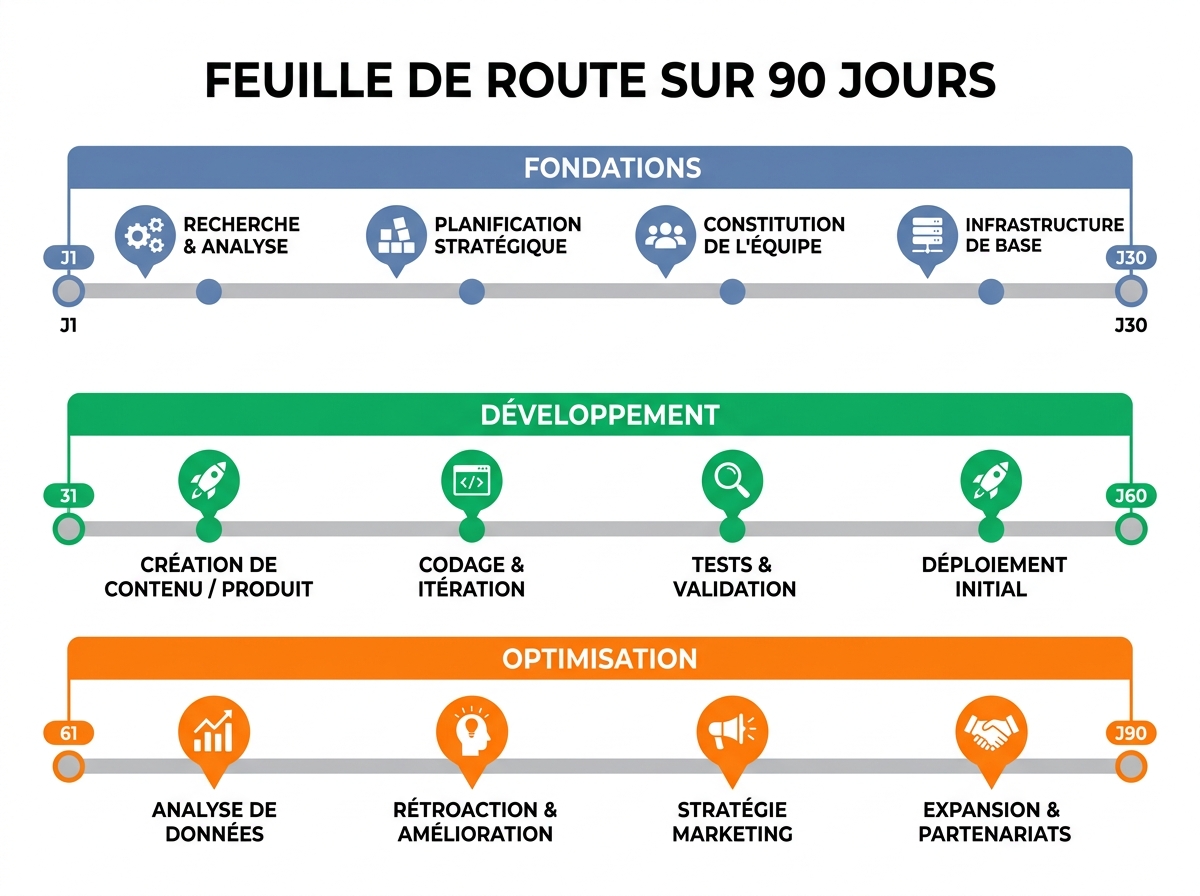
Here's a realistic action plan, tested on French SMEs.
Days 1–30: Laying the foundations
- Create or claim your Google Business Profile listing
- Complete 100% of the fields (hours, categories, description, attributes)
- Publish 5 to 8 professional photos (facade, interior, team, products)
- Contact your top 10 customers to get their first reviews
- Audit NAP consistency on the 5 main directories
Days 31–60: Building presence
- Create 2 to 3 local pages on your website (service + city)
- Launch a systematic review collection sequence (email or SMS post-service)
- Publish 2 GBP posts per week
- Identify 5 priority local keywords with a tool like Google Search Console
- Correct detected NAP inconsistencies
Days 61–90: Optimise and measure
- Analyse GBP performance (views, calls, directions) in the Google dashboard
- Publish 1 local blog article targeting a long-tail keyword
- Respond to all received reviews (goal: 100% response rate)
- Identify local backlink opportunities (regional press, associations, partners)
- Plan a semantic SEO audit to refine your content strategy
Mistakes that sabotage your local visibility

Certain mistakes are made by the majority of SMEs — and they cost dearly in lost opportunities.
Incorrect or outdated opening hours. A customer who travels for nothing won't come back. And Google penalises listings whose information seems unreliable.
Ignoring negative reviews. Not responding to a negative review is worse than the review itself. A professional and empathetic response often turns around the reader's perception.
Generic local pages. Copy-pasting the same text and just changing the city name is duplicate content that Google detects and devalues. Each local page must have unique and specific content.
Neglecting photos. Listings with more than 100 photos receive 520% more calls than those with fewer than 10 photos (Google, internal data). This is one of the most underutilised levers.
Waiting for everything to be perfect before starting. Local visibility is built over time. An imperfect but active listing is better than a perfect listing published six months later.
Measuring what really matters
Local visibility is not just measured in Google rankings. The operational indicators that matter for an SME:
- Number of calls generated from the GBP listing (visible in insights)
- Directions requests (strong signal of visit intent)
- Clicks to the website from the listing
- Number and average rating of reviews (month-on-month evolution)
- Local organic traffic on service + city pages (Google Search Console)
This data should be tracked monthly. If an indicator stagnates, it's a call to action — not a fatality. The Digitalyser visibility audit provides an accurate diagnosis of each of these areas in less than 48 hours.
Local visibility and AI: the new playing field
In 2026, an additional dimension becomes essential: being cited by AI agents. When a user asks ChatGPT or Gemini "which plumber near me in Toulouse", the answer is generated from structured, consistent, and reliable sources. SMEs that have worked on their entity reputation — structured data, consistent mentions, numerous and recent reviews — appear in these answers. Others do not.
This is not science fiction: it's already the case for dozens of sectors. The good news is that the fundamentals of local SEO (NAP consistency, reviews, local content) are also the fundamentals of GEO. You don't have two strategies to pursue — you have one, well executed.
If you want to know where you stand today on these two dimensions, the most effective starting point remains a complete visibility audit: it gives you an accurate snapshot of your situation and action priorities for the next 90 days.