


Your customers decide in a matter of seconds whether they trust you – and that decision is made online, long before they even contact you. Modernising your digital communication is no longer an option reserved for large brands: it's the number one lever for staying a leader in your sector.
Why digital communication determines your leadership position
80% of purchasing decisions start with an online search (source: Think with Google). In other words, if your digital presence is outdated, inconsistent, or non-existent, you're losing customers before they even have a chance to speak to you.
Outdated communication sends three negative signals:
- A lack of innovation that questions the quality of your products or services
- A perceived slow responsiveness, especially compared to highly present competitors
- A vague positioning that doesn't reassure buyers during the comparison phase
Conversely, SMEs that invest in modern and consistent communication strengthen their brand authority, build loyalty more easily, and capture hesitant prospects. It's not a question of budget: it's a question of method.
Conduct an audit of your current communication
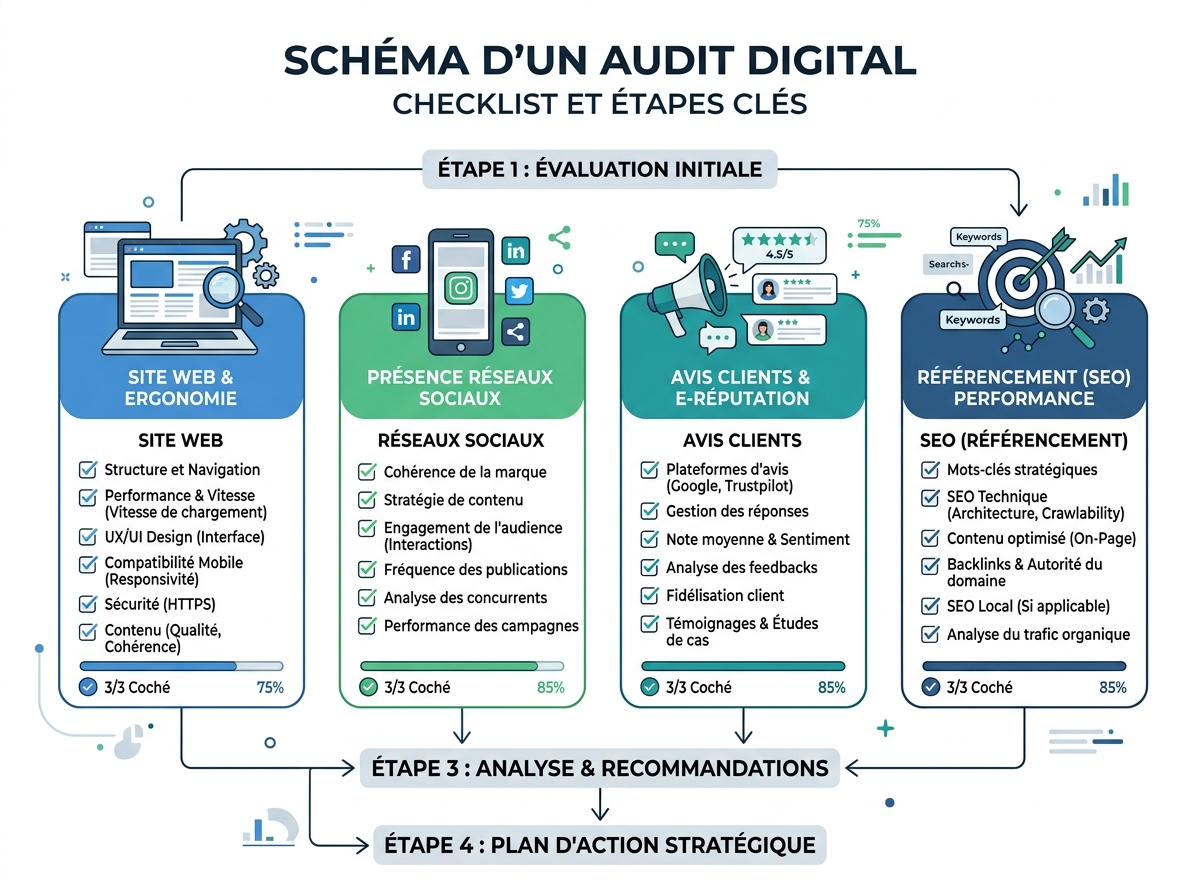
Before changing anything, make an honest diagnosis. A digital communication audit is an X-ray of your real visibility: what Google sees, what your prospects see, and the gap between the two.
Here are the four areas to evaluate:
- Website: Is it fast (Core Web Vitals score > 75), mobile-responsive, and up-to-date in both content and form?
- Social media: Are your profiles active, visually consistent, and aligned with your current positioning?
- Online reputation: Do your Google reviews, mentions, and Google Business Profile give a reliable and modern image?
- SEO: Do you appear for key queries in your sector, including in the responses of AI assistants like ChatGPT or Gemini?
In practice, many SMEs discover during an audit that their site is no longer indexed correctly, or that their Google listing displays outdated information. These are silent leaks, difficult to detect without a dedicated tool. Digitalyser's 360° visibility audit can identify them in minutes.
Update your website: your number one digital shop window

Your website is often the first point of contact with a prospect. An outdated design or a loading time exceeding 3 seconds is enough to make 53% of mobile visitors flee (source: Google/SOASTA). That's as many potential customers lost before they even read your offer.
Priority projects:
- Design: Modernise visuals, simplify navigation, declutter pages. A clean site inspires more trust than an overloaded one.
- Technical performance: Optimise images, enable caching, switch to HTTPS if not already done.
- Content: Update your service pages, prices, testimonials. Outdated content signals a company that isn't keeping up.
- Calls to action: Each page should guide the visitor towards a clear action – get in touch, request a quote, read an article.
A technical SEO audit helps prioritise these corrections based on their real impact on your visibility and conversion.
Cultivate your image on social media
Social media is not an optional channel for SMEs: it's proof of life. A profile inactive for six months is a red flag for a hesitant prospect.
But be careful: regularity without strategy is useless. Here's what really works:
- Visual consistency: Use the same colours, fonts, and tone across all your channels. Brand identity is built through repetition.
- Useful content > promotional content: Posts that explain, advise, or illustrate your expertise generate 3 to 5 times more engagement than purely commercial posts.
- Reasonable frequency: 2 quality posts per week are better than 7 generic posts. Consistency over 6 months always beats a 3-week sprint.
Tools like Buffer or Hootsuite allow you to schedule content, but they don't replace an editorial strategy. Without a clear guideline, you produce volume without impact – and you burn out.
Leverage social proof to inspire trust
Social proof is one of the most powerful conversion levers in both B2C and B2B. According to BrightLocal, 87% of consumers read online reviews before choosing a local business. Your Google reviews, customer testimonials, and case studies are strategic assets – not just decorations.
How to activate them concretely:
- Systematically request a review after each successful service (automated email, QR code, direct link)
- Respond to all your reviews, positive and negative – this shows your seriousness
- Integrate customer verbatim on your site, with first name, job title, and if possible, a photo
- Publish mini case studies on your networks: "Problem → Solution → Result"
A frequently overlooked point: AI agents like ChatGPT or Perplexity rely on online mentions to construct their responses when a user asks a question about your sector. A solid and documented reputation increases your chances of being cited by these assistants – this is called GEO visibility (Generative Engine Optimization). It's a differentiator still little exploited by French SMEs.
Automate and professionalise your communication
Modernising your communication also involves operational efficiency. Automating repetitive tasks frees up your time for high-value actions.
Some high-ROI automations for an SME:
- Email marketing: Welcome, re-engagement, or loyalty sequences with tools like Brevo (formerly Sendinblue). Note: Brevo remains a sending tool – it doesn't replace a content strategy or overall performance monitoring.
- Light CRM: Centralise your contacts and track your opportunities. Even a well-structured spreadsheet is better than scattered information.
- Automated reporting: Connect Google Analytics, Search Console, and your social media to get a consolidated view of your performance each week.
The real question isn't "which tool to choose?" but "what data allows me to make better decisions?". This is where support makes perfect sense: tools alone don't make the strategy.
From visibility to growth: connect all your channels
A common mistake among SMEs: treating each channel as an independent silo. The website on one side, social media on the other, Google reviews elsewhere. The result: a fragmented presence that dilutes your message and complicates the measurement of your results.
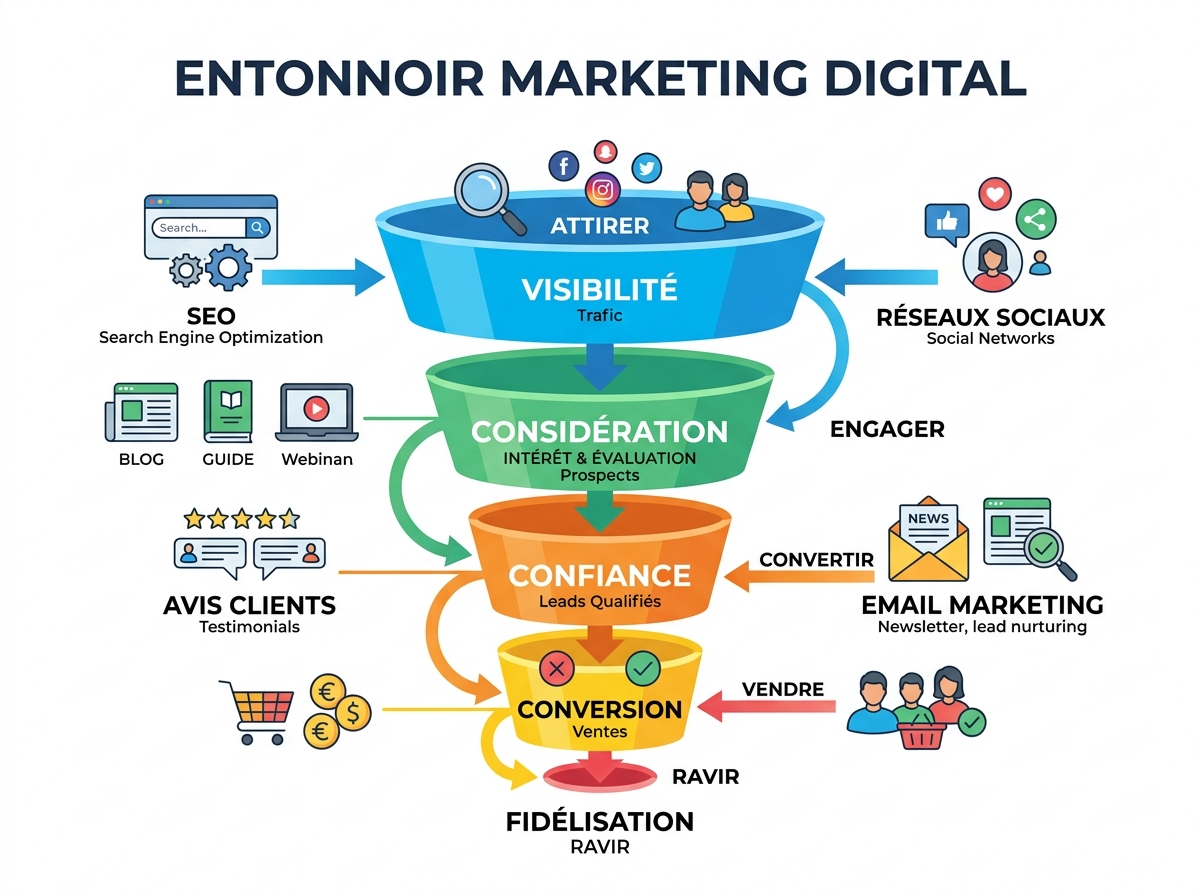
Modern digital communication works as a coherent funnel:
- Be visible: SEO, Google Business Profile, presence on relevant platforms
- Be chosen: e-reputation, social proof, content that demonstrates expertise
- Capture demand: clear calls to action, optimised landing pages, conversion tracking
This triptych – See, Choose, Convert – is the guiding principle of any effective communication strategy. Digitalyser structures its support around these three pillars to help SMEs not miss any of the steps.
If you haven't yet evaluated your position on each of these axes, a free audit is the fastest starting point. You'll know exactly where you stand – and where to act first to regain control of your visibility.