


Many SMEs publish regularly but never see a single contact request. The problem isn't the volume of content — it's the method. 82% of marketers believe their 2024 content strategy was effective (HubSpot, 2025), but most of them had clear objectives from the outset. For SMEs that improvise, the outcome is often the opposite.
Good news: there are simple principles, used by pros, that you can apply today — without being a copywriter or marketing expert.
Get inside your audience's head before writing a single line

Knowing your target audience is the number one condition for high-performing content. Not vaguely ("my clients are entrepreneurs"), but precisely: what problems keep them awake at night? What words do they use to describe them?
Ask yourself these concrete questions:
- Who is your ideal client? (sector, company size, role, daily constraints)
- What obstacle is preventing them from moving forward today?
- What result do they hope to achieve in 3 months?
- What format do they naturally consume? (articles, short videos, newsletters, podcasts, etc.)
To answer these questions without a research budget: read comments on your posts, explore forums and Facebook groups in your sector, analyse your competitors' Google reviews. These are often ignored goldmines.
Speaking your audience's exact language is already selling without forcing it.
This step dictates everything else. Content that resonates with your target's words will be shared, commented on, and most importantly, remembered. It's also what makes you visible in the responses of AI agents like ChatGPT or Perplexity: these tools cite sources that precisely answer users' questions.
Create content that transforms, not just fills space
Your audience isn't looking to read for pleasure. They're looking for concrete solutions to real problems. A post that says "Discover our services" offers nothing. A post that says "3 express rituals to calm anxiety before a meeting" provides immediate value.
Formats that truly make a difference for an SME:
- Short, impactful posts: one idea, one problem, one solution. Nothing more.
- Educational carousels: ideal for explaining a process in 5 to 7 steps.
- Short, authentic videos: 84% of consumers were convinced to buy after watching a brand video (Wyzowl, 2025). No studio needed.
- Customer testimonials: the most underutilised format by SMEs, yet the most credible.
The golden rule: every piece of content must answer a specific question your target audience is asking. If you can't formulate that question in one sentence, the content isn't ready yet.
A semantic audit can help you identify exactly what questions your audience is asking — and which you're not yet answering.
Structure your messages with the AIDA method
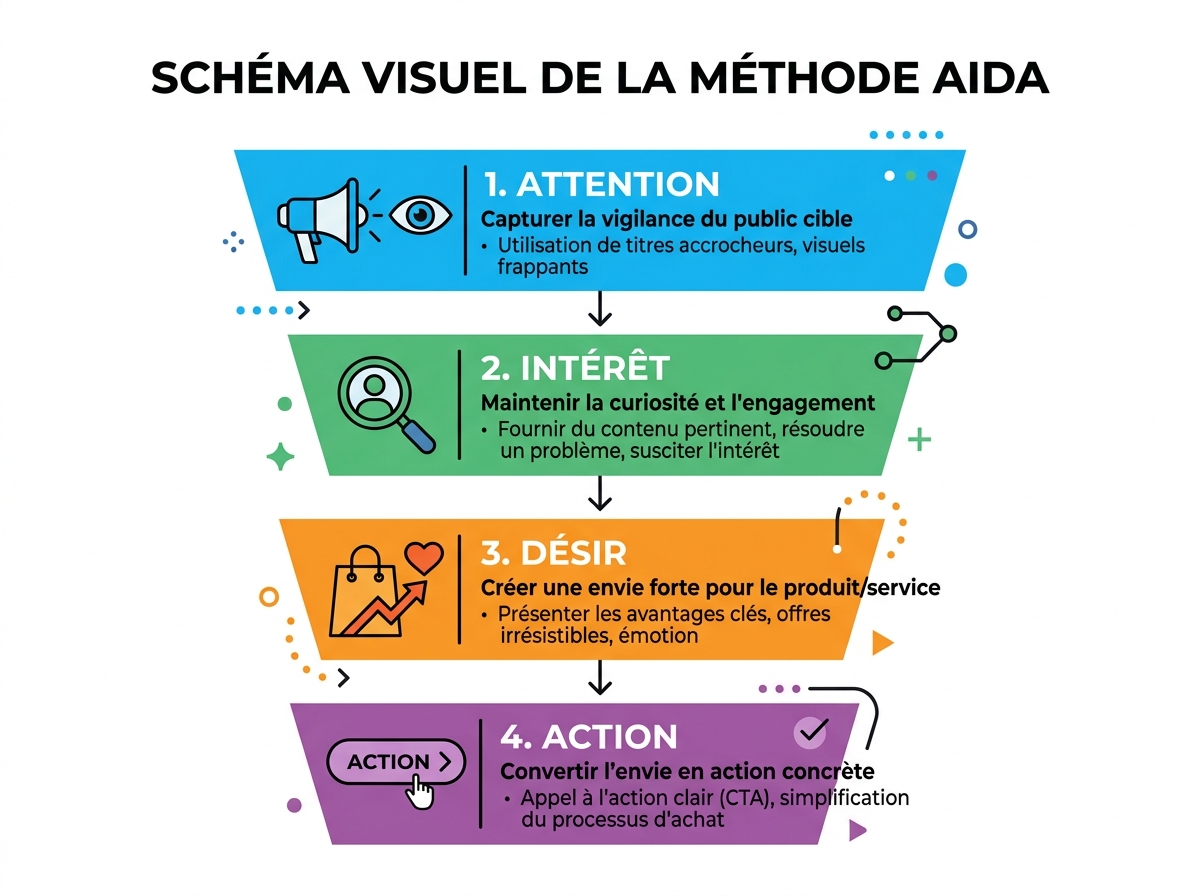
You don't need to be a copywriter to write a post that grabs attention and encourages action. The AIDA method (Attention – Interest – Desire – Action) is a proven framework, used for a LinkedIn post as well as a sales page.
How to apply it in practice
Attention — The hook must interrupt the scroll. Ask a provocative question, contradict a common belief, or announce a surprising result.
Interest — Describe the problem your reader is experiencing. Use their words, not yours.
Desire — Show that the solution exists and is accessible. Give a concrete example, a figure, a before/after.
Action — Tell them exactly what to do: "Download", "Comment", "Book an appointment". Only one action per piece of content.
Concrete example:
- ❌ "Can't find clients on Instagram?"
- ✅ "3 mistakes sabotaging your Instagram visibility — and how to fix them this week."
The second version sparks curiosity AND promises a tangible result. That's the difference between an ignored post and a shared post.
Recycle your existing content rather than creating more

The classic SME trap: publishing continuously, burning out, then giving up. Content professionals don't create more — they optimise better.
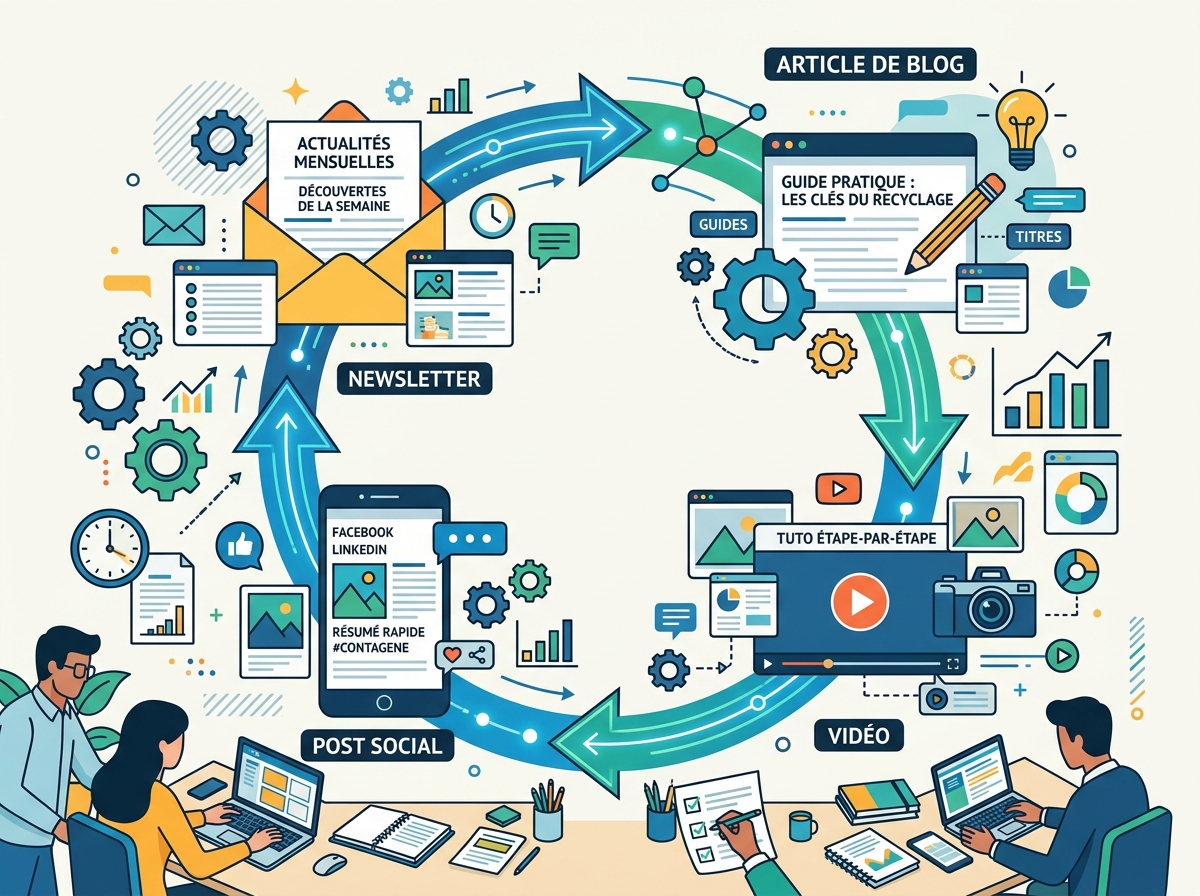
A single well-designed piece of content can generate 5 to 10 variations:
- A blog post → 5 LinkedIn or Instagram posts
- A YouTube video → a newsletter + a carousel
- A high-performing old post → updated with new visuals and recent data
- A customer testimonial → a short case study + a graphic quote
Start by analysing your 5 best pieces of content from the last 6 months. What do they have in common? Format, subject, tone, publication time? Start from there rather than inventing new topics every week.
This strategic recycling approach reduces production pressure while increasing the consistency of your online presence. It also builds a reputation as a solid entity in the eyes of search engines and generative AIs.
Add a clear call to action to every piece of content
This is the most often forgotten step — and the most costly in terms of missed conversions. Your audience won't guess what they should do after reading your content. You need to tell them explicitly.
A good call-to-action (CTA) meets three criteria:
- A single action: don't ask them to comment, share, and book an appointment all at once.
- A clear benefit: "Download the guide" is less effective than "Download the guide and double your email open rate".
- A sense of urgency or ease: "In 2 minutes" or "Today" reduce mental friction.
Examples of effective CTAs for an SME:
- "Book your free diagnostic — response within 24 hours"
- "Comment with your sector and I'll send you 3 post ideas"
- "Download the checklist — it's free and immediate"
Without a CTA, even the best content remains an investment without measurable return.
Measure what works and adjust without delay
Publishing without measuring is like driving without a dashboard. Yet, 42% of marketing teams admit that the lack of precise objectives is the main cause of their content strategy's inefficiency (Content Marketing Institute, 2025).
For an SME, the key metrics to track are simple:
- Engagement rate (likes, comments, shares): indicates if the topic resonates.
- Traffic generated to your site: visible in Google Analytics or Search Console.
- Contact or quote requests resulting from the content: the only indicator that truly matters.
Accessible tools without a budget: Google Search Console (free), Meta Business Suite (free), Google Analytics 4 (free). Solutions like Semrush or Ahrefs exist, but their learning curve and cost (often €100 to €500/month) reserve them for dedicated marketing teams — not SMEs managing their content alongside their main activity.
A more suitable approach: a 360° visibility audit that gives you a clear understanding of what's working, what's blocking you, and what deserves to be prioritised — without having to master a dozen different tools.
Is your content visible where your customers are looking?
Producing good content is no longer enough if no one finds it. In 2026, your customers will be looking for answers on Google, but also on ChatGPT, Perplexity, and Google's AI Overviews. Being cited by these AI agents is becoming a visibility lever in its own right.
To appear there, your content must:
- Answer precise questions formulated in natural language
- Be structured so that each section is understandable in isolation
- Be based on sourced data and concrete examples
- Be published on a technically sound website (speed, structure, tagging)
This is exactly what Digitalyser's See → Fix → Prove approach covers: identifying what hinders your visibility, correcting blocking points, then measuring the results. If you haven't yet reviewed your online presence, a free audit is the best starting point — no commitment, with actionable recommendations from the first read.