


According to several recent studies, 60% of searches now end without a click. Generative AIs – ChatGPT, Gemini, Perplexity – answer your potential customers directly. If your site doesn't speak their language, you're simply absent from the conversation.
What AIs "see" (or don't see) on your site
AI engines don't read a site like a human. They look for structured signals: tags, formats, named entities. A technically clean but poorly tagged site looks, to an AI, like raw text without a title or context. It doesn't know if you're an accounting firm or a restaurant. Nor does it know if your FAQ adequately answers the user's question.
The good news: these signals are accessible to any SME. They don't require rebuilding your site from scratch. They require precise and methodical compliance.
Schema.org structured data: speaking the language of engines
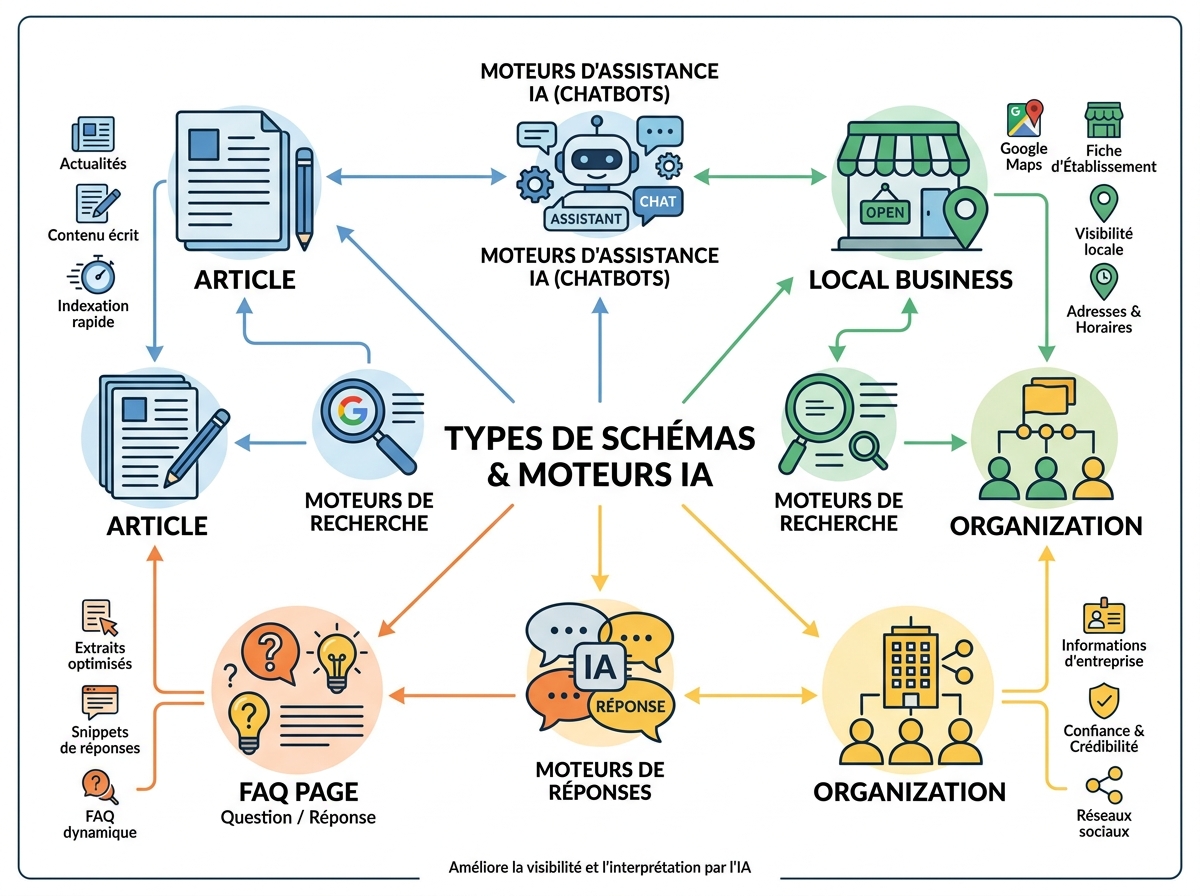
Structured data are blocks of code (usually JSON-LD) inserted into a site's pages to explicitly describe their content to search engines and AIs. Schema.org is the reference vocabulary, maintained by Google, Microsoft, and Yahoo.
Specifically, four types of schemas are priorities for an SME:
- Article: indicates that a page is editorial content, with author, publication date, and subject. Favours citations in generative responses.
- LocalBusiness: provides the name, address, opening hours, phone number, and geographical area. Fundamental for local visibility in AIs.
- FAQPage: structures questions and answers that can be extracted directly. A blog post with FAQ markup is much more likely to feed an AI response.
- Organization: describes the company as an entity – logo, social networks, identifiers, sector. This is the basis of entity reputation recognised by AIs.
A Parisian plumber who implements aLocalBusinessschema with their opening hours, service area, and customer reviews gives AIs enough context to cite them when a user types "emergency plumber Paris 11th" into Perplexity.
According to Google, pages correctly tagged with structured data are better represented in AI Overviews and rich results – two surfaces that capture attention even before the first classic organic result.
Semantic markup: beyond the code
Structured data is not limited to JSON-LD blocks. Semantic markup also refers to how your HTML content is organised: correct use of <h1>, <h2>, <article>, <section>, <address> tags – and lang, alt, aria-label attributes.
An H1 that exactly matches the page's subject, H2 titles that answer real questions, <address> tags around your contact details: all this creates semantic coherence that AIs easily navigate. Conversely, a site built only with nested <div>s without logical hierarchy remains opaque to intelligent crawlers.
Internal linking also plays a role: it structures the topography of your expertise in the eyes of the engines. a "Services" page that links to detailed pages by service, themselves tagged Service, forms a coherent entity graph.
Entity consistency: being recognised as a reliable source
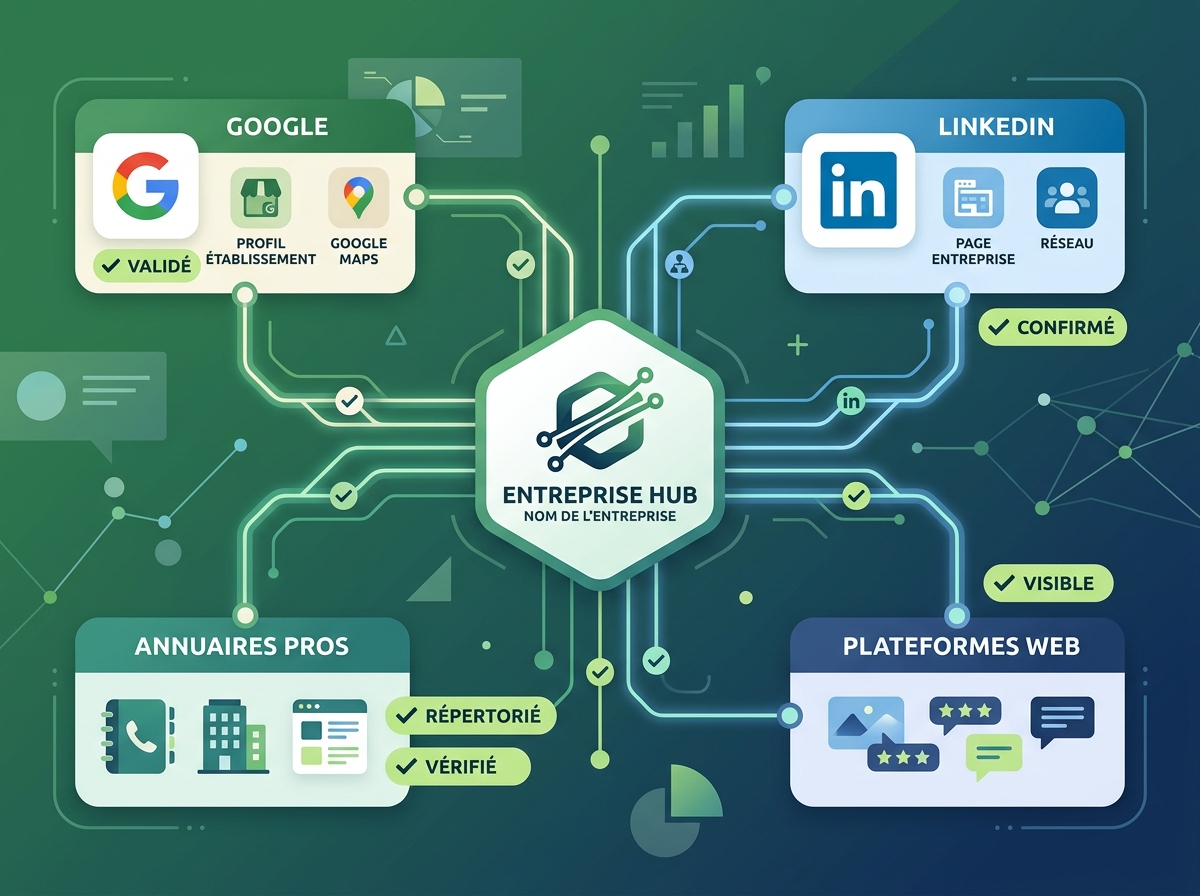
Entity consistency is a central concept of GEO (Generative Engine Optimization). An entity is a uniquely identifiable thing or person: your company, your founder, your city, your flagship product.
For an AI to cite you, it must be able to identify you with certainty. This assumes that:
- Your company name is identical on your site, your Google Business Profile listing, your LinkedIn, Yelp, Yellow Pages, and other directory profiles.
- Your address follows the same format everywhere (full street name, postcode).
- Your
Organizationschema includessameAspointing to your official profiles. - Your content authors have an author profile linked to their LinkedIn page or bio.
A typical case encountered in the field: an SME with three different spellings of its name depending on the platforms (with and without a comma, with or without "SAS"). The result – AIs create several distinct entities, dilute trust, and never cite the correct source. Correcting these inconsistencies is often the first step, and the quickest to implement.
Discover how a complete semantic audit can identify these flaws before they cost you prospects.
The llms.txt file: an emerging signal to monitor
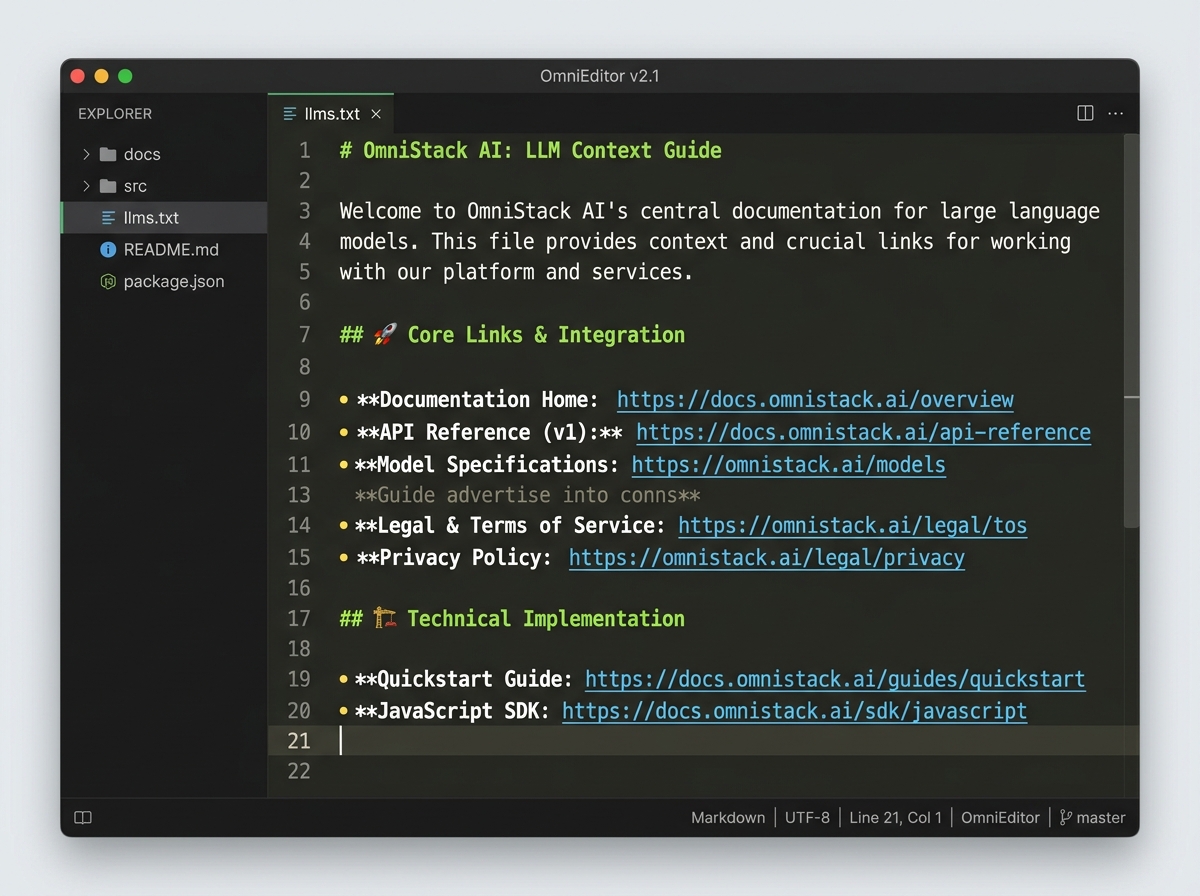
The llms.txt file is a standard proposed in 2024 to guide language models (LLMs) towards a site's priority content. Placed at the root of the domain (e.g., mysite.com/llms.txt), it functions somewhat like a robots.txt – but instead of prohibiting, it recommends.
Its Markdown structure is simple:
```
MyCompanyName
Short description of the activity and added value.
Services
About
- Our Story
```
In 2026, no major AI player – OpenAI, Google, Anthropic – has yet officially adopted this standard. Experts agree on one point: the llms.txt file should not be your number one priority. Implementing it does not replace structured data, a good robots.txt, or an up-to-date sitemap.
But ignoring it completely would be an error of excessive caution. Several third-party platforms and specialised crawlers are starting to use it. And above all, preparing it forces useful discipline: synthesising your offering, prioritising your key pages, clarifying your identity for a machine.
The most accurate analogy: llms.txt is to AI what the business card was to the first business meeting. It's not enough, but it's the right reflex.
What this concretely changes for your local and generative visibility
Generative AIs aggregate multiple signals before citing a source. Your generative visibility therefore depends on a combination of:
- Complete and valid structured data
- Entity consistency between your site and your third-party presences
- Content that answers your customers' real questions (answer-first format)
- Domain authority (backlinks, brand mentions)
For local visibility specifically, a well-filled LocalBusiness schema, combined with a consistent Google Business Profile listing, becomes a duplicate signal that Gemini and Google AI Overviews interpret as proof of reliability. SMEs in competitive local markets (construction, healthcare, catering) are seeing measurable gains in geolocated responses simply by correcting these technical inconsistencies.
Tools like Semrush or Screaming Frog can audit some of these signals – but their handling remains complex for an SME without dedicated technical resources, and their GEO coverage remains partial. A structured approach by a specialised partner is often more effective, especially for the entity consistency part, which goes beyond the scope of a classic crawler.
Concrete action plan for an SME in 6 steps
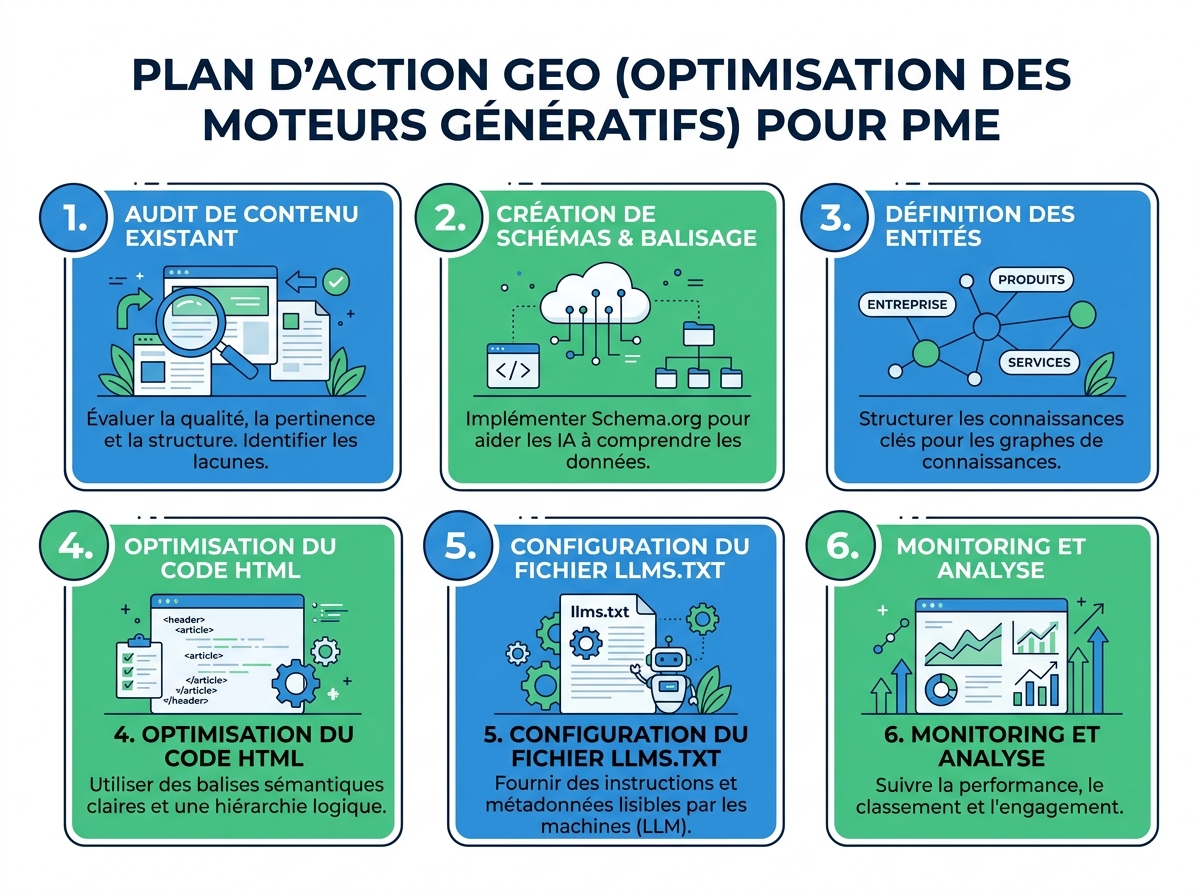
Here's how to get started without a full-time developer:
- Audit the existing: check your site for markup errors with Google Rich Results Test and validate your sitemap.
- Implement priority schemas:
Organizationsite-wide,LocalBusinesson the contact/home page,FAQPageon question pages,Articleon the blog. - Harmonise your entities: align name, address, phone number, and description across all your profiles (Google, LinkedIn, directories).
- Structure your HTML: check H1/H2/H3 hierarchy, use HTML5 semantic tags, refine image
altattributes. - Create the llms.txt file: prepare a summary of your activity and list your key pages in Markdown at the root.
- Monitor AI citations: regularly track whether your brand appears in ChatGPT, Perplexity, and Gemini responses for your target queries.
These six steps form the foundation of a site that is truly readable by AIs. Most can be achieved in a few days with the right support – without touching your site's architecture.
If you want to know exactly where you stand, a 360° visibility audit identifies the technical, semantic, and entity consistency flaws that hinder your generative visibility. And to go further on content and netlinking strategy that strengthens your entity authority, discover Digitalyser's SEO services.