


93% of French people consult online reviews before buying — and most of them will never ask for your opinion on what they've read. Your local reputation is built, distorted, and spread without you typing a single line. Here's how to take back control.
What Google aggregates about your business (without telling you)

Google has effectively become the first page of your business. Even before an internet user visits your website, they see your Google Business Profile listing: name, address, phone number, opening hours, photos, average rating, recent reviews, Q&A, and even attributes automatically generated by the algorithm.
But that's not all. Google also builds a Knowledge Panel — a sidebar that summarises what the search engine "knows" about your entity. It aggregates information from Wikipedia, Wikidata, your website, directories, press articles, and mentions across the web. One in two business owners is unaware that this panel exists for their company, and even more are unaware of what it actually contains.
The concrete result: a potential customer might read an outdated description, an old address, a negative article on the first page, or unanswered reviews — and decide to go to a competitor in less than 30 seconds.
Entity Reputation: The concept few SMEs know about
Entity reputation refers to how Google — and generative AIs — perceive and qualify your business as a coherent knowledge object. It's not just your 5-star rating. It's the sum of signals the engine associates with your name: business category, geographical area, reviews, mentions in third-party sources, consistency of NAP (Name, Address, Phone) information across the web.
The more consistent and positive these signals are, the more Google trusts you to display you — in the local pack, in the Knowledge Panel, and now in its AI Overviews (AI-generated summaries at the top of search results). According to the IFOP & Guest Suite 2026 study, 27% of French people already use AI as their first search reflex. If your entity is poorly defined or inconsistent, you simply won't exist in these responses.
Negative signals that harm your reputation without you knowing
Here are the most common problems identified in SMEs:
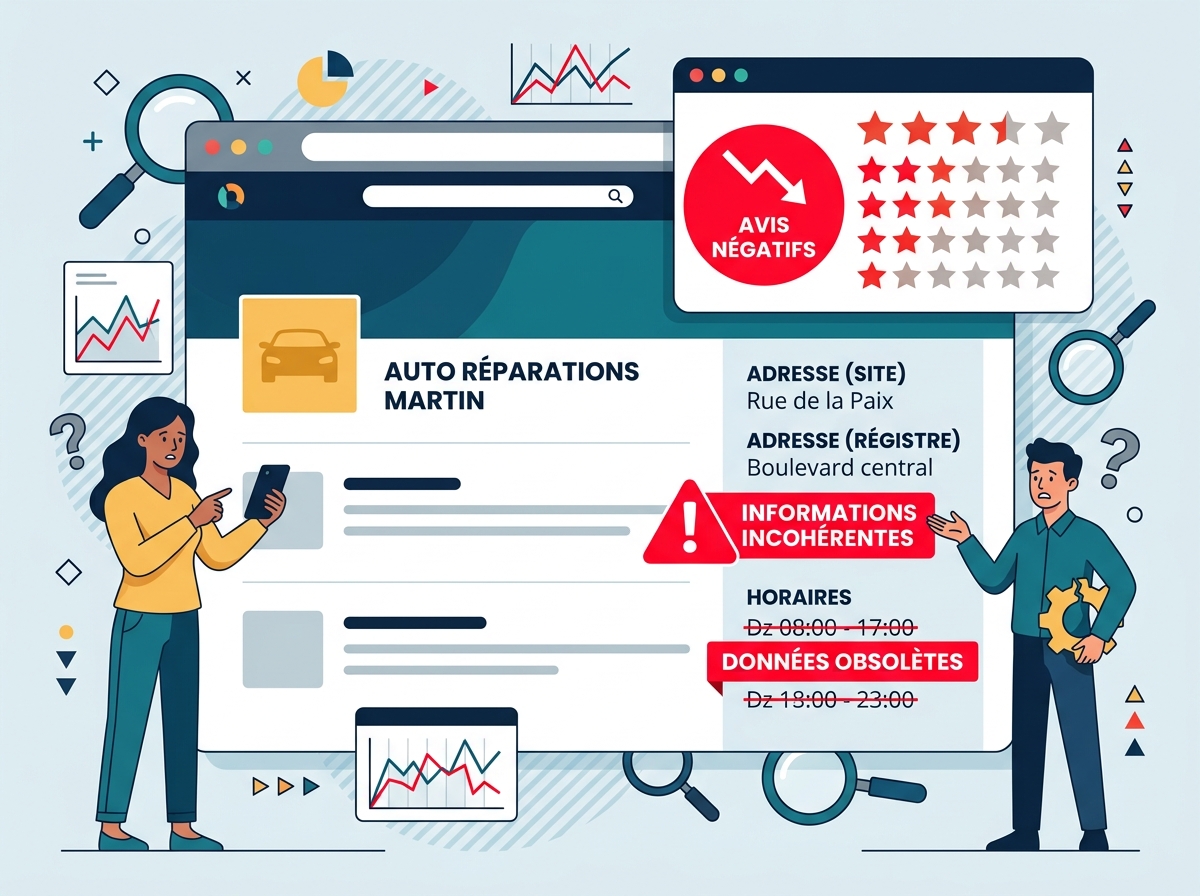
- NAP inconsistency: your address is written differently on your website, Pages Jaunes, Yelp, and your Google listing. Google interprets this as a degraded reliability signal.
- Unanswered negative reviews: 96% of consumers read negative reviews to judge how problems are handled (Trustt, 2025). An unanswered negative review is perceived as implicit validation.
- Outdated information: unupdated opening hours, old phone number, photos from 2018. These details seem minor — they cost real customers.
- Negative mentions in the press or forums: a blog post, a local forum post, a poorly rated Trustpilot page can appear on the first page for your name.
- Lack of brand content: if you don't produce content under your own name, others will do it for you.
A single negative review deters 40% of potential buyers (Trustt, 2025). Multiply this figure by the monthly search volume for your name, and the impact becomes very real.
How to audit your reputation footprint in under an hour
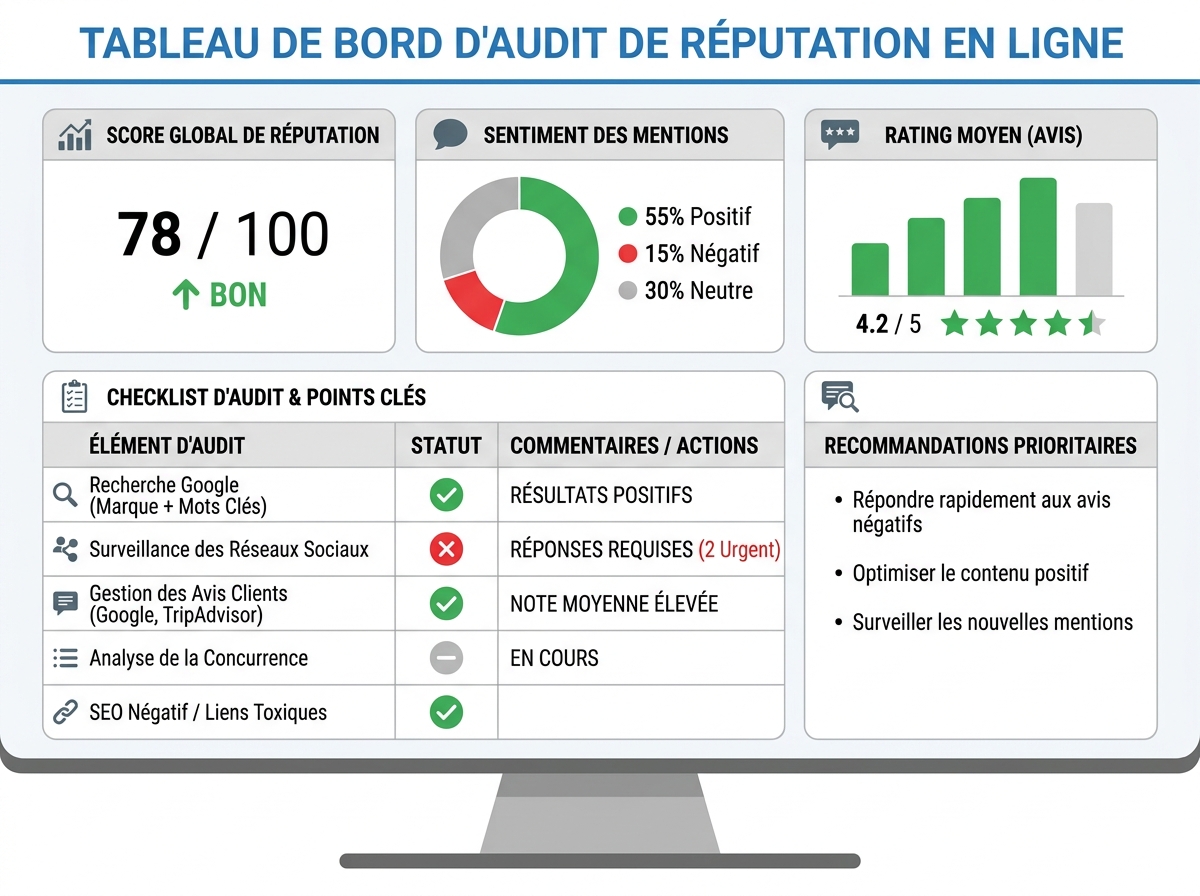
Before correcting, you need to measure. Here's a structured method:
1. Google your own name (in incognito mode)
Open an incognito tab and type the exact name of your business. Note: what appears in the Knowledge Panel, the first 10 organic results, visible reviews, associated questions ("People Also Ask").
2. Check NAP consistency on major directories
Pages Jaunes, Yelp, Tripadvisor, Foursquare, Apple Maps, Bing Places. A single discrepancy is enough to blur the entity signal. Tools like Yext or Partoo allow centralising this management — but their cost and complexity make them unsuitable for SMEs without support. This is precisely why Digitalyser's 360° visibility audit integrates this diagnosis into an actionable report.
3. Analyse your reviews on all platforms
Average rating, volume, date of the last review, response rate. An account with 12 reviews, the last of which is 14 months old, sends a signal of disengagement. According to Trustt, 77% of consumers don't trust reviews older than three months.
4. Identify third-party content about your name
Use Google Alerts (free) with your business name in quotation marks. You'll know what's being said about you in real-time.
Taking back control: the 4 actionable levers
Lever 1 — Unify your NAP information Choose a canonical version of your name, address, and phone number. Deploy it identically across all channels: website, social media, directories, email signature. This is the foundation.
Lever 2 — Activate a review collection strategy Not asking for reviews means leaving the field open to unhappy customers (who, in contrast, spontaneously take the time to write). Implement a simple process: SMS or email post-purchase with a direct link to your Google listing. 82% of satisfied customers agree to leave a review when asked at the right time.
Lever 3 — Systematically respond to reviews, both positive and negative 56% of consumers prefer brands that respond to reviews (Trustt, 2025). A professional response to a negative review often changes the reader's perception. Respond within 48 hours, personalise, don't get defensive — offer a solution.
Lever 4 — Produce brand content Blog articles, press releases, detailed "About Us" pages, active LinkedIn profiles: every piece of content you publish under your name strengthens your entity reputation and pushes negative signals down in the results. This is also what allows generative AIs to cite you correctly.
E-reputation and AI visibility: the link no one explains to you

ChatGPT, Perplexity, Gemini, Google's AI Overviews — all these systems draw on the same signals as traditional SEO, but with an additional requirement: entity consistency and authority. For an AI to cite you in a response to "best plumber in Lyon" or "reliable accounting firm in Bordeaux," your entity must be clearly defined, well-documented, and positively referenced across multiple independent sources.
An incomplete Google listing, unmanaged reviews, and NAP inconsistency don't just lower your local rating — they make you invisible in AI responses. This is the new hidden cost of a neglected e-reputation.
According to the IFOP 2026 study, 66% of French people believe that AI accelerates their purchasing decisions. If you're not in the AI's answer, you're not in the decision.
What Digitalyser does that generic tools don't
Platforms like Partoo or BrightLocal allow managing certain aspects of local reputation — but they are designed for experienced marketing teams, with complex interfaces and pricing intended for franchise networks or large brands. For an SME or VSE, the cost/value ratio is rarely worthwhile.
The Digitalyser approach is different: it starts with an e-reputation and netlinking audit that maps your entire digital footprint — reviews, mentions, NAP consistency, Knowledge Panel, entity signals — and produces a prioritised action plan, readable without technical expertise. The goal is not to sell you another dashboard subscription, but to give you a clear vision and concrete actions.
If you don't know exactly what Google is saying about you right now, it's a good time to find out. Start with a free audit of your visibility — you'll get a first snapshot of your online reputation in minutes.