


Nearly 37% of French SMEs report difficulty finding a suitable marketing provider — and this figure has jumped by 15 points in one year (France Num 2025 Barometer). In other words, outsourcing your marketing is not a trivial decision: poorly prepared, it costs time, money, and credibility. Well prepared, it changes a company's trajectory.
Why outsource your marketing: the real reasons (not the clichés)

Outsourcing marketing involves entrusting all or part of your communication and acquisition actions to external professionals — agencies, consultants, specialised platforms. It's not an easy way out: it's a strategic choice.
The legitimate reasons are concrete:
- Access to rare skills: Technical SEO, Google Ads advertising, online reputation management — these disciplines require years of practice that few SMEs can develop internally.
- Reduce the true cost: Recruiting a senior marketing manager costs between €45,000 and €65,000 per year in France (salary + charges). Targeted outsourced support often costs 10 to 20% of this budget.
- Gain agility: An external team can be mobilised or scaled down according to growth phases, without HR constraints.
- Avoid blind spots: An external perspective detects visibility flaws that an internal team no longer sees.
However, 55% of VSE/SME leaders cite lack of time as the primary barrier to digital upskilling (France Num 2025). This lack of time is precisely what drives outsourcing — and what makes preparation essential.
The 4 mistakes SMEs repeat when outsourcing
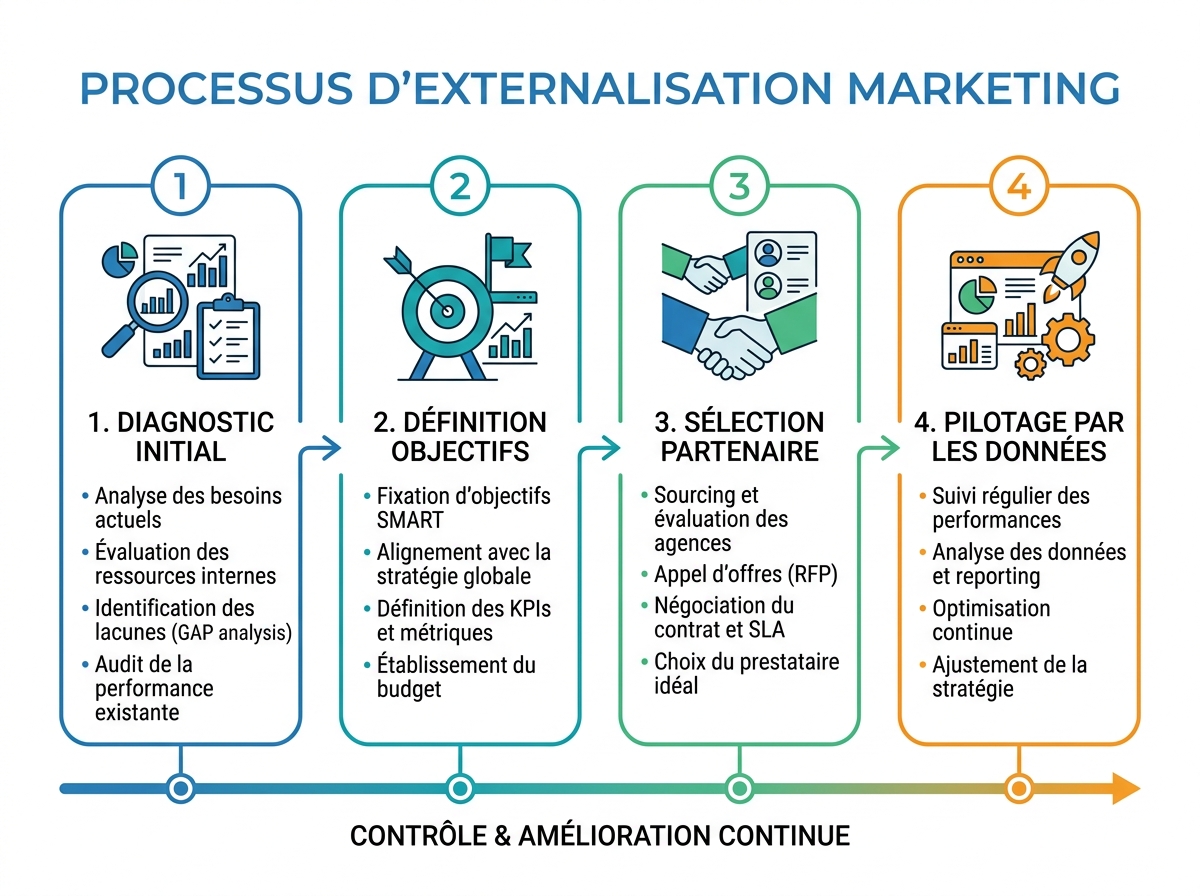
In practice, marketing outsourcing failures almost always follow the same pattern. Here they are, unfiltered.
Mistake #1: Delegating without a brief or objective
This is the most common. The manager entrusts marketing to a provider with a vague instruction: "we want more visibility". Without measurable objectives (qualified traffic, monthly leads, conversion rate), it's impossible to evaluate performance — or to course-correct if things go awry.
A good brief defines: the precise target, priority channels, expected KPIs at 3 and 6 months, and the budget allocated per lever.
Mistake #2: Choosing based on price, not relevance
A freelancer at €300/month who promises to "do everything" (SEO + social media + emailing + advertising) is an impossible promise. Digital marketing is a specialist's job. It's better to have a partner who masters 2 or 3 levers in depth than a generalist who only scratches the surface of everything.
Always ask for sectoral references and quantified results — not dashboard screenshots without context.
Mistake #3: Losing contact after signing
Outsourcing doesn't mean disappearing. SMEs that achieve the best results maintain a weekly or bi-weekly meeting with their provider. This dialogue allows for real-time adjustment of actions, sharing of on-the-ground information that the agency cannot guess, and staying aligned with business priorities.
Mistake #4: Ignoring AI visibility and entity reputation
In 2025-2026, being visible is no longer limited to Google. ChatGPT, Gemini, and Perplexity directly answer consumer questions — and cite companies. If your brand is not structured as a credible entity (complete Google Business Profile, consistent mentions across the web, recent reviews), you don't exist in these answers. This is a blind spot that most generalist providers still ignore.
How to outsource effectively: the 4-step process
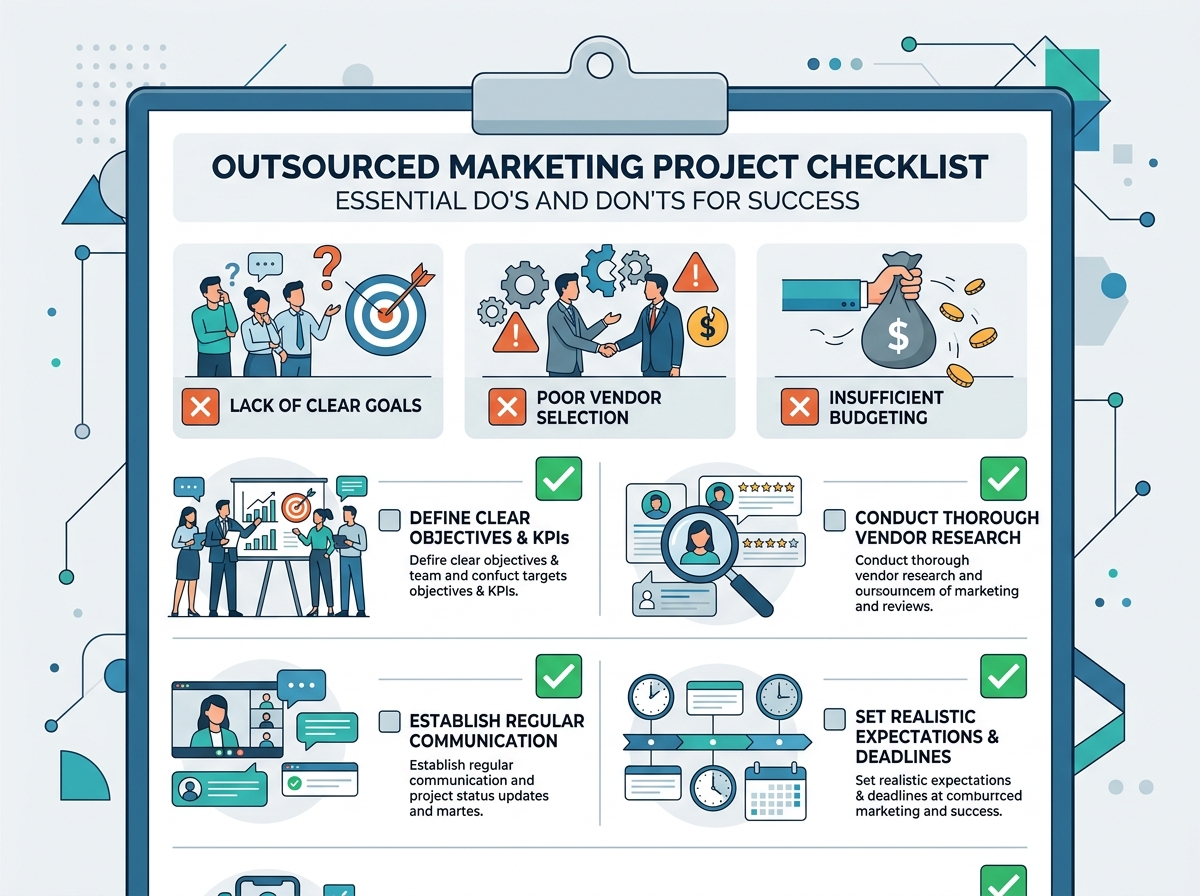
Here's the method we recommend to SMEs before signing anything.
Step 1 — Audit your current situation
Before delegating, know where you stand. A 360° visibility audit gives you a precise snapshot: SEO positioning, state of your online reputation, consistency of your local information, technical performance of your site. Without this diagnosis, you risk paying to optimise secondary channels while leaving critical flaws open.
Step 2 — Define your objectives by horizon
Distinguish between short-term objectives (generating quote requests within 90 days) and medium-term objectives (building sectoral authority over 12 months). These two horizons do not involve the same levers: Google Ads SEA responds quickly, while organic SEO and entity reputation build over time.
Step 3 — Choose a partner based on 3 non-negotiable criteria
- Demonstrated sectoral experience: Have they worked with companies comparable to yours?
- Transparency on methods: Can they clearly explain what they will do and why?
- Reporting capability: Do they provide you with actionable data, not just vanity metrics?
Beware of tools like Semrush or Ahrefs sold as self-service, ready-made solutions for SMEs: their learning curve is real, their monthly cost often exceeds €100, and they require expertise to be used correctly. They are designed for already structured marketing teams, not for a manager juggling everything else.
Step 4 — Manage with simple, regular indicators
Three indicators are sufficient for effective monthly monitoring:
- Qualified organic traffic (sessions from relevant searches)
- Number of leads or contact requests generated per channel
- Reputation score (average rating, volume of recent reviews, online mentions)
Add a quarterly review to re-evaluate priorities and reallocate the budget if necessary.
What Digitalyser offers that traditional agencies don't
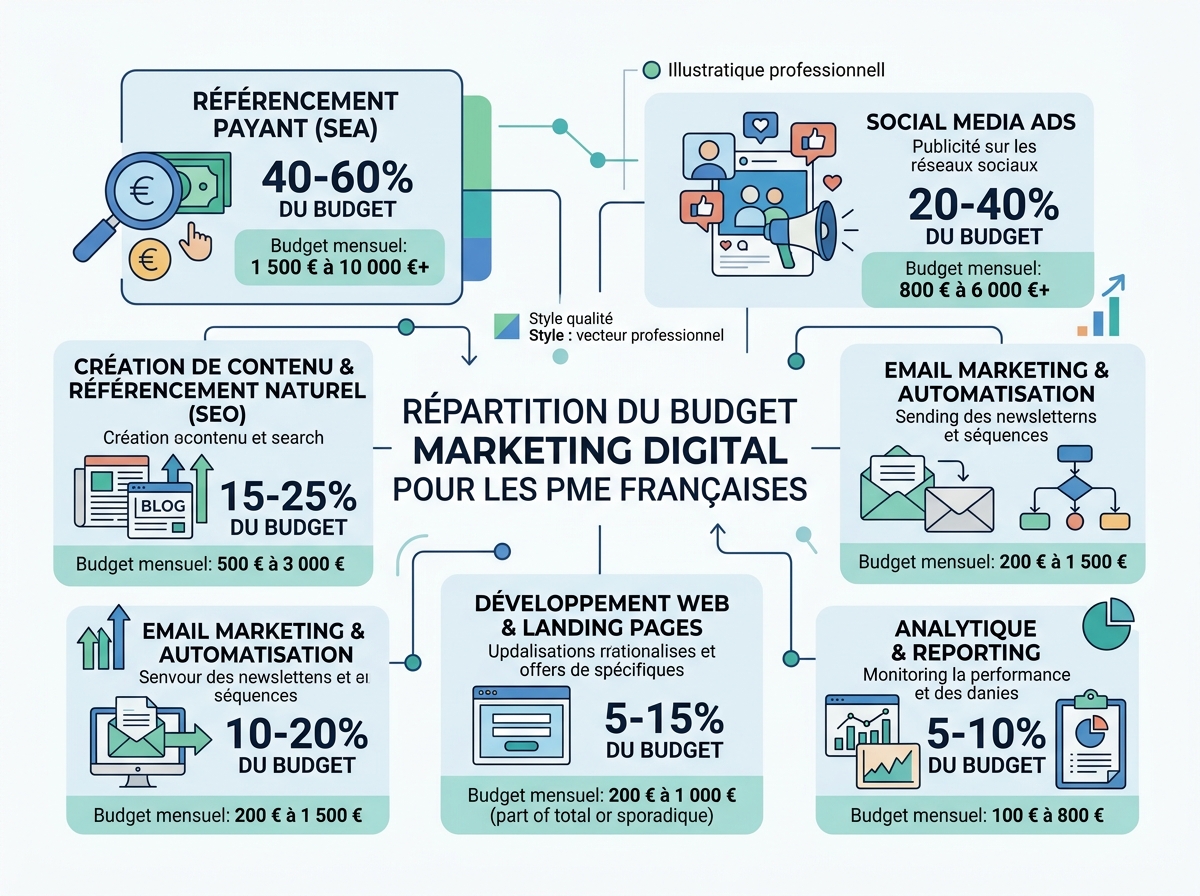
Digitalyser is designed for SMEs and VSEs who want complete, measurable visibility adapted to the AI era — not a generic service resold to 50 identical clients.
Specifically, the platform covers the three pillars of digital growth:
- Be visible: Local SEO, optimisation for Google's AI Overviews, structuring your entity's reputation to be cited by AI agents.
- Be chosen: E-reputation management, consolidation of customer reviews, consistency of information across all directories.
- Capture demand: Data-driven Google Ads SEA campaigns, netlinking and e-reputation to strengthen your authority.
Where tools like Partoo or BrightLocal focus on local listing management — useful, but partial — Digitalyser integrates the entire funnel into a unified approach, designed for managers who don't have time to juggle five dashboards.
3 signs that indicate you are ready to outsource
You don't need to wait until everything is perfect. Here are three concrete signs:
- You spend more than 5 hours a week on marketing tasks with no measurable results.
- Your competitors appear above you on Google for your key queries — and you don't know why.
- Your Google Business Profile is incomplete, your reviews are more than 6 months old, and you have no strategy to remedy this.
If you tick at least two of these boxes, outsourcing is no longer an option: it's a priority.
Taking action: where to start concretely
The first step is not to sign a contract with an agency. It's to understand your real situation.
A free visibility audit gives you a clear overview of your strengths, weaknesses, and priority levers to activate in just a few minutes. This is the foundation on which to build intelligent outsourcing — not a leap of faith.
Outsourcing without a diagnosis is like entrusting your car keys to a mechanic without telling them what's wrong. Start with the diagnosis. The rest follows naturally.
To delve deeper into the levers to activate, explore our SEO and digital visibility services or discover all our support offers.