

60% of Google searches now end without a click. Meanwhile, ChatGPT exceeds 900 million weekly active users worldwide and processes 2.5 billion queries per day. If your visibility strategy still relies solely on traditional SEO, you're missing out on a growing portion of your potential customers – without even knowing it.
Classic SEO vs. GEO: Two Fundamentally Different Logics
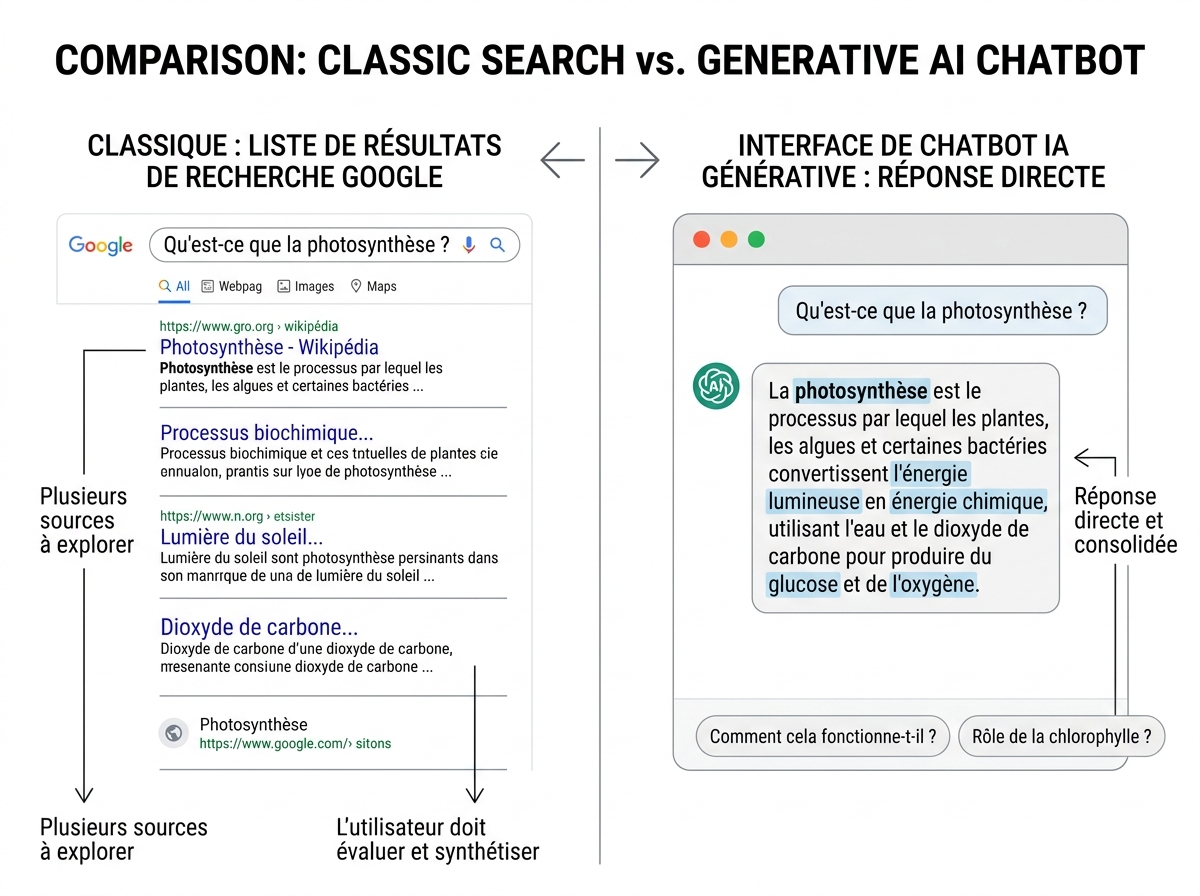
Traditional SEO (Search Engine Optimization) aims to position your pages in Google's results by working on keywords, backlinks, and technical structure. The promise: to appear in the list of links that the user browses to find their answer.
GEO (Generative Engine Optimization) follows an inverse logic. Generative engines – ChatGPT, Google Gemini, Perplexity, Google's AI Overviews – don't list links. They synthesise a direct answer, citing sources they deem reliable, structured, and extractable. Your goal is no longer to be in position 1: it's to be cited in the answer.
These two disciplines are not opposed, but they don't obey the same rules. Ignoring GEO in 2026 means optimising for a channel that is losing ground every quarter.
What Generative Engines Concretely Change
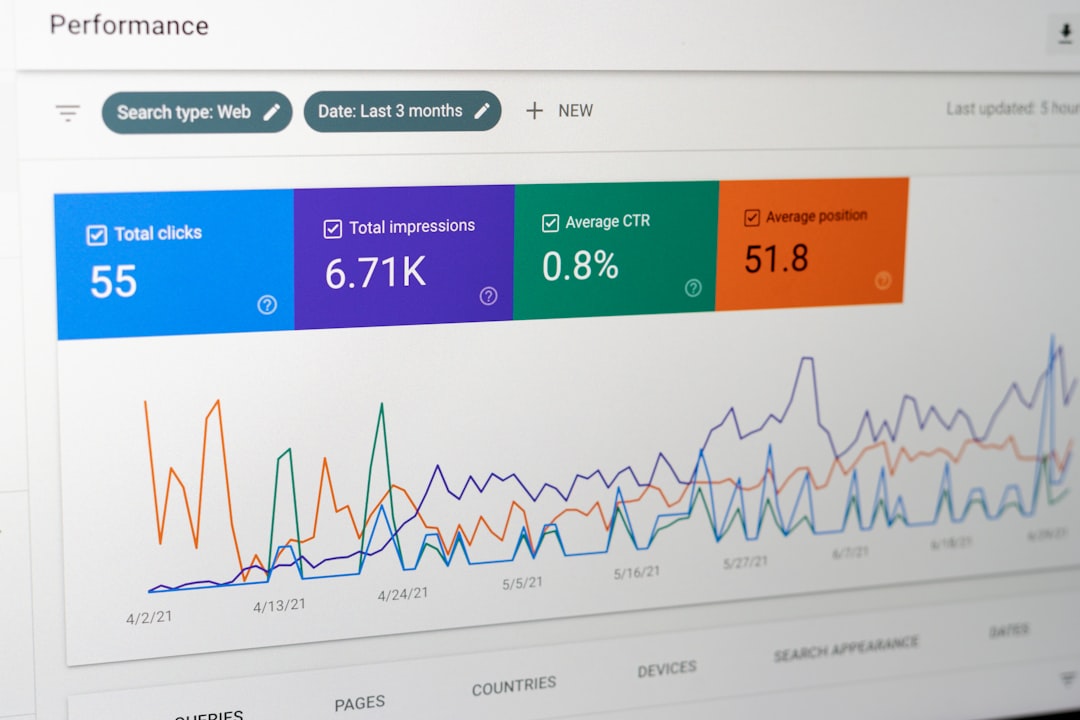
When a user queries ChatGPT or consults a Google AI Overview, they no longer see ten blue links. They get a written, sourced, often definitive answer. Result: the CTR in position 1 on Google dropped by 34.5% for pages exposed to AI Overviews (Ahrefs, March 2025), and up to 58% after the December 2025 update.
Generative engines favour content that:
- Directly answers the question from the first sentence (answer-first format)
- Contains sourced and verifiable numerical data
- Is structured with semantic tags (Schema.org, JSON-LD)
- Comes from a recognised entity: identified author, cited brand elsewhere, strong E-E-A-T signals
- Has been recently updated – 50% of content cited by AI is less than 13 weeks old (Similarweb, June 2025)
An article well-positioned on Google but written like a keyword catalogue will never be cited by an LLM. Form matters as much as substance.
New GEO Levers Not Covered by Classic SEO
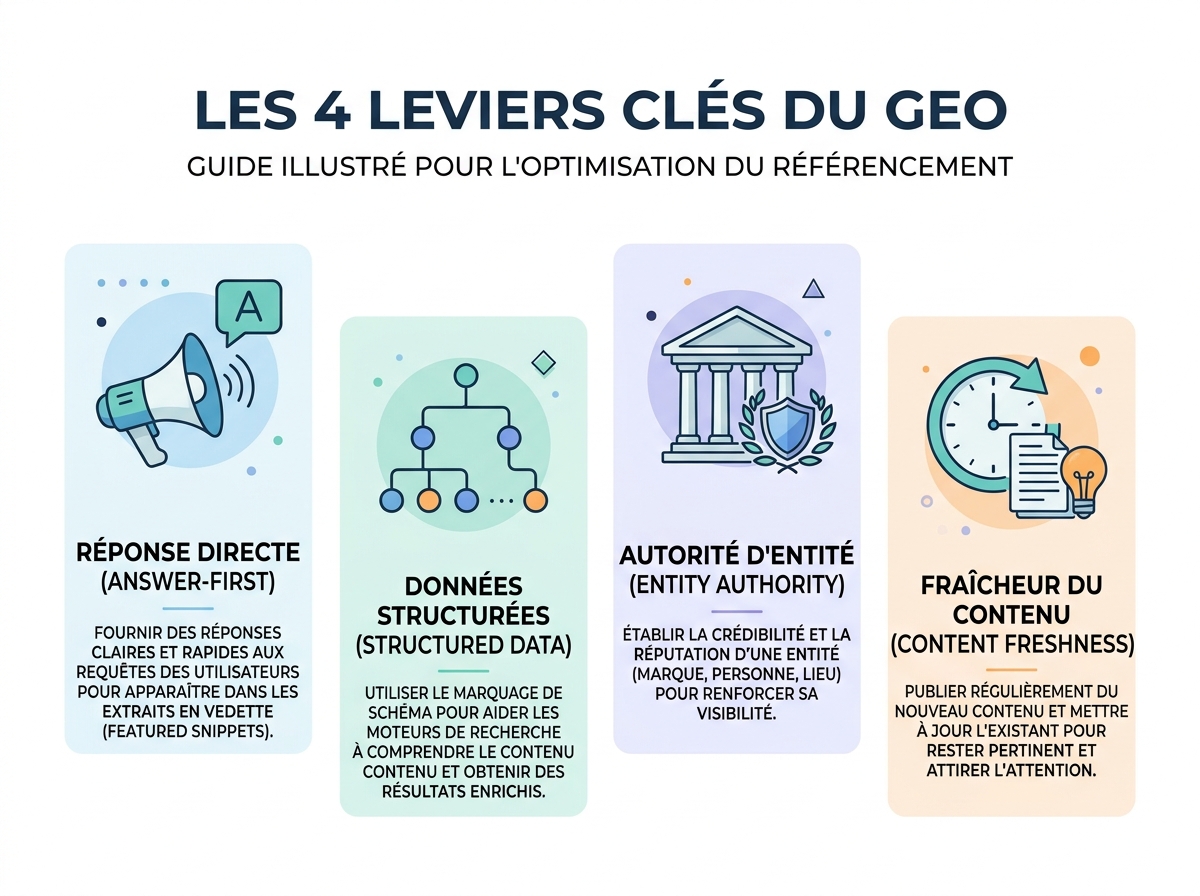
Traditional SEO works on keywords, PageRank, and loading speed. GEO introduces different levers, often absent from classic SEO audits.
Entity Authority
Generative engines reason by entities (brands, people, places, concepts), not by keywords. Being recognised as a reliable entity – via mentions in media, structured data, a consistent Google Business Profile – directly increases the likelihood of being cited. This is called entity reputation, a signal that Semrush or Ahrefs do not natively measure.
Extractable and Answer-First Content
Each section of your content must be understandable out of context, as a standalone answer. AI extracts fragments, not entire pages. A paragraph that begins with "As we saw earlier..." will be ignored. A paragraph that begins with "The average processing time for a request is 48 hours" will be cited.
Structured Data (Schema.org)
Schema.org tags – FAQ, HowTo, Article, LocalBusiness – allow generative engines to understand the nature and reliability of your content. This is a directly actionable technical lever, but underutilised by the majority of French SMEs.
Freshness and Update Frequency
Unlike classic SEO where an article can last for years, AI favours recent content. Updating your key pages every 2 to 3 months is no longer optional: it's a condition for visibility.
Why Expert SEO Tools Are No Longer Enough
Semrush, Ahrefs, Screaming Frog: these tools are powerful, but they were designed for a world of links and keywords. Their cost – often between €120 and €500 per month – and their learning curve effectively reserve them for agencies and large companies with dedicated SEO teams.
But above all, they do not measure visibility in AI answers. They don't tell you if ChatGPT cites you, if your entity is recognised by Gemini, or if your content is extractable by AI Overviews. For an SME looking to understand all of its digital visibility in 2026, these tools offer a partial – and increasingly incomplete – view.
This is exactly the problem Digitalyser was designed to solve: global SEO + GEO visibility, designed for SMEs, without requiring prior technical expertise.
What a Complete Visibility Strategy Must Cover in 2026
A modern approach to visibility for an SME must articulate three pillars:
- Be visible: technical SEO, structured content, local presence (Google Business Profile), and now AI discoverability – being cited by generative engines.
- Be chosen: e-reputation, customer reviews, online entity consistency. An LLM that hesitates between two companies will cite the one with the strongest and most documented reputation.
- Capture demand: conversion, acquisition, SEA. Attracting traffic is useless if the page doesn't convert.
According to Gartner, traditional search volume is expected to decrease by 25% by the end of 2026. In parallel, referral traffic sent by AI platforms increased by 357% in one year (Similarweb, June 2025). The shift is underway – and it's accelerating.
Concretely, for an SME, this means: auditing existing content to identify extractable pages, structuring FAQs with Schema.org, strengthening entity authority signals (press mentions, NAP consistency, verified profiles), and producing regularly updated answer-first content.
How Digitalyser Supports SMEs with SEO and GEO

Digitalyser is the only platform designed for SMEs that covers the complete visibility funnel: from natural referencing to optimisation for generative engines, including e-reputation and netlinking.
Unlike expert tools like Semrush or Ahrefs – costly, complex, designed for specialists – Digitalyser translates technical signals into concrete actions, understandable by an SME manager without a dedicated marketing team. The 360° visibility audit analyses both your classic SEO positioning and your extractability by AI: entity authority, content structure, structured data, reputation consistency.
In 2026, 32% of French SMEs already use ChatGPT in their activity (source: Sébastien Vallat, 2026). But how many have checked if their customers find them via these tools? This is the question posed by a free Digitalyser audit – and the answer often changes the priority of actions to be taken.
Classic SEO remains an indispensable foundation. But without GEO, you are building on ground whose surface shrinks every month. The real question is not "should we do GEO?" – it's "how many customers have you already lost by not being there?"