


93% of French people read online reviews before acting — and 83% have already abandoned a purchase due to negative reviews (IFOP & Guest Suite 2026 study). Yet, the majority of SMEs manage their Google reviews reactively, or not at all. Here's how to turn the tide.
Why Google Reviews Have Become a Strategic Asset

Google reviews are no longer just a barometer of satisfaction: they directly influence your local visibility and conversion rate. According to BrightLocal, 81% of consumers check Google reviews before visiting a physical store. And highly-rated customers spend up to 31% more.
For local SEO, Google incorporates the volume, recency, and quality of reviews into its Local Pack ranking algorithm (the top 3 map results). A listing with 50 recent reviews and a 4.5 rating consistently outperforms a blank listing, even if your website is technically flawless.
Another often-ignored dimension: reviews now feed into AI agent responses (ChatGPT, Gemini, Perplexity). When a user asks "which plumber in Lyon does good work?", these tools aggregate online reputation signals. Being well-rated also means being cited by AI.
The 5 Mistakes (Almost) All SMEs Make

Before building a strategy, you need to identify what's already sabotaging your reputation.
1. Never Asking for Anything
The number one mistake: passively waiting. Satisfied customers don't spontaneously leave reviews — dissatisfied customers do. The result: your rating reflects your worst experiences, not your actual service level.
2. Buying or Fabricating Fake Reviews
A real temptation, with serious consequences. Google detects suspicious reviews via behavioural signals (IP, recent accounts, clusters of simultaneous submissions). A flagged listing can be suspended. Moreover, 68% of consumers are wary of a listing with no negative reviews — artificial perfection is counterproductive.
3. Only Responding to Negative Reviews (or Not Responding at All)
Ignoring positive reviews is a missed opportunity to strengthen customer relationships. Not responding to negative reviews means leaving the last word to a dissatisfied customer in front of thousands of prospects. 56% of consumers prefer brands that respond to reviews (Trustt, 2025).
4. Responding Defensively or Generically
"We are sorry for your experience, please feel free to contact us" — this copy-paste type of response convinces no one. It signals a lack of attention and worsens negative perception.
5. Ignoring Reviews Older Than 3 Months
77% of consumers don't trust reviews older than 3 months. A listing with 40 reviews from 2 years ago is less reassuring than a listing with 10 reviews from last month. Regularity trumps raw volume.
Implementing Ethical and Effective Review Collection
Ethical review collection is based on a simple principle: soliciting the right customers, at the right time, through the right channel. Here's a 3-step method.
Step 1 — Identify the moment of maximum satisfaction. This is right after a successful service delivery, a problem resolution, or an in-store purchase. This is when the customer is most likely to share a positive experience.
Step 2 — Simplify the path. Create a short, direct link to your Google review form (available in your Google Business Profile). Integrate it into your follow-up emails, SMS messages, invoices, email signature, or a QR code at the checkout.
Step 3 — Personalise the request. A generic message generates few responses. Mention the customer's first name, the service provided, and explain in one sentence why their review genuinely matters to you.
Example message: "Hi Sophie, thank you for your trust when we installed your boiler last week. If you have 2 minutes, your Google review really helps us get known locally: [link]. Thank you!"
Absolutely to be avoided: offering a discount or gift in exchange for a positive review. This is a violation of Google's T&Cs and a deceptive practice under French consumer law.
Responding to Positive Reviews: The Art of Turning a Customer into an Ambassador
Responding to a positive review takes 30 seconds and has two effects: the customer feels recognised (and returns), and prospects see that you are attentive. A few rules:
- Personalise: mention a detail from the review, not a generic phrase.
- Thank without overdoing it: "Thanks for the feedback, that's exactly what we aim for" is better than "Your satisfaction is our absolute priority."
- Naturally slip in a local keyword: "Glad our plumbing team in Bordeaux could respond quickly" strengthens your local SEO.
Typical template:
"Thank you very much [First Name]! Your feedback on [service] really means a lot to us. The whole team will be delighted to welcome you again."
Responding to Negative Reviews Without Worsening the Situation

A well-managed negative review can become your best sales argument. Prospects read your responses as much as the reviews themselves — they want to know how you react under pressure.
The 4-Part Structure
- Acknowledge receipt without defending yourself: "Thank you for your feedback, even if it's difficult to read."
- Acknowledge the experience (without necessarily admitting fault): "I understand that the wait seemed long to you."
- Propose a solution or direct contact: "I invite you to call me directly on [number] so we can find a solution together."
- Keep it brief and professional: never more than 5-6 lines.
What you should never do: publicly dispute the facts aggressively, mention private customer details, or promise an action you won't deliver.
Concrete example: a restaurant receives a 1-star review for excessive waiting time on a Saturday night. The good response: "Good evening, thank you for your honesty. Saturday evening service is indeed our busiest time and we were not up to par that night. Please feel free to contact us again, we will give you special attention on your next visit."
Turning Your Reviews into a Visibility and Conversion Lever
Reviews don't just live on Google. Once collected, leverage them across all your channels.
- Website: integrate a Google review widget on your homepage and service pages. This reduces bounce rate and increases trust.
- Social media: regularly share screenshots of positive reviews (with the implicit consent of the public customer). This is authentic social content, without a budget.
- Quotes and commercial proposals: insert 2-3 customer testimonials into your sales documents. A hesitant prospect is often convinced by social proof.
- Google Business Profile: respond to reviews with relevant local keywords. Google indexes the content of your responses.
Regarding tools, platforms like Partoo or Yext allow centralising review management across multiple platforms. Useful for large multi-site brands, but often oversized — and costly — for an SME managing 1 to 3 establishments. Digitalyser's 360° visibility audit integrates the analysis of your e-reputation into a global vision, without unnecessary complexity.
Managing Your Reputation Over Time
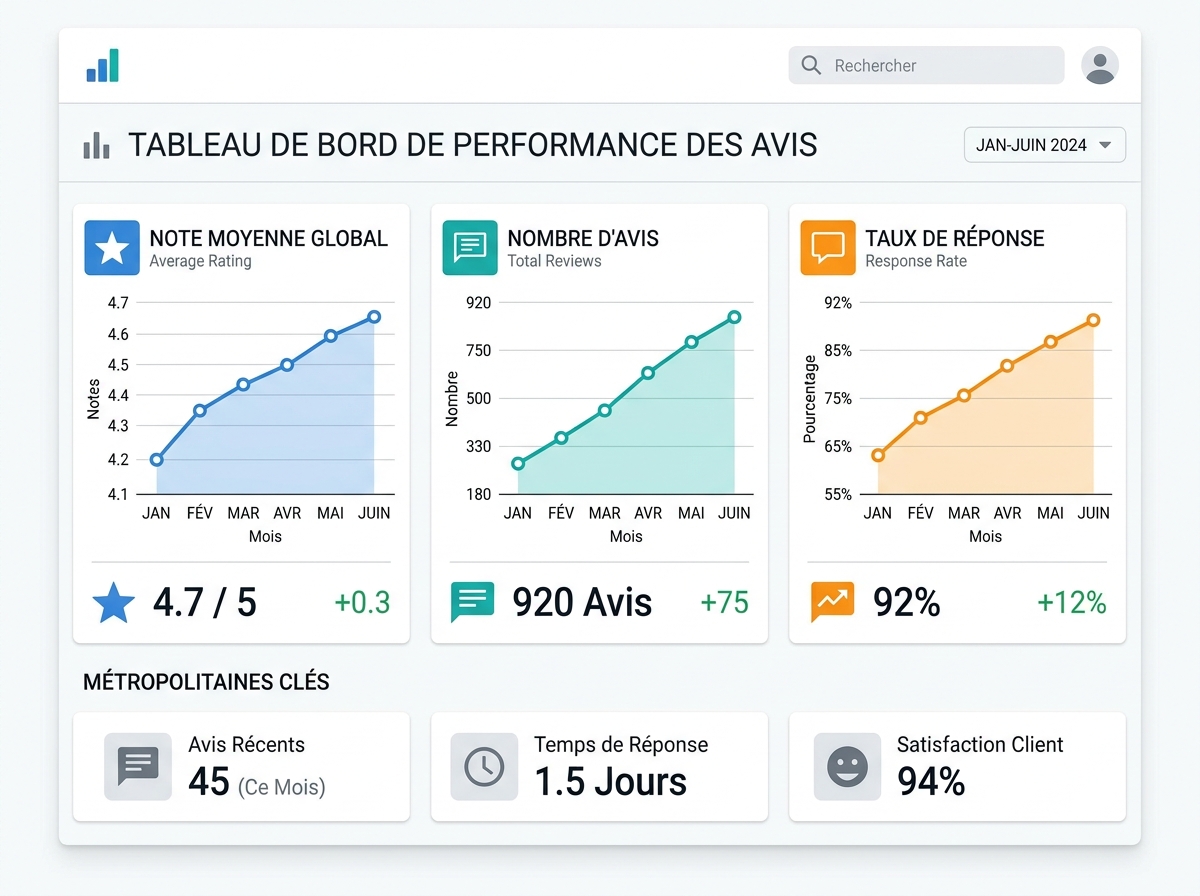
A good Google rating is not a given: it must be maintained. A few indicators to monitor each month:
- Average rating and evolution over 30/90 days
- Number of new reviews (goal: at least 2-3 per month for micro-businesses, 5-10 for active SMEs)
- Response rate: aim for 100% — Google values it and prospects notice it
- Recurring keywords in reviews (positive and negative): they reveal your real strengths and operational blind spots
If you manage several establishments or your reputation has been neglected for months, a reset is necessary. Digitalyser's e-reputation support is designed for SMEs who want to regain control without spending hours each week.
Google reviews are probably the most underutilised — and most accessible — lever for French SMEs. No need for an advertising budget: just a method, regularity, and the willingness to treat every customer as a potential ambassador. If you want to know where you really stand, a free audit gives you a complete snapshot of your local visibility in minutes.