

Every day you don't have optimised tags, you're handing clicks to your competitors. A well-written meta description can increase your click-through rate by +43% — without affecting your Google ranking (MyLittleBigWeb, 2026). This is perhaps the most underutilised SEO lever for SMEs.
What Google displays even before your site
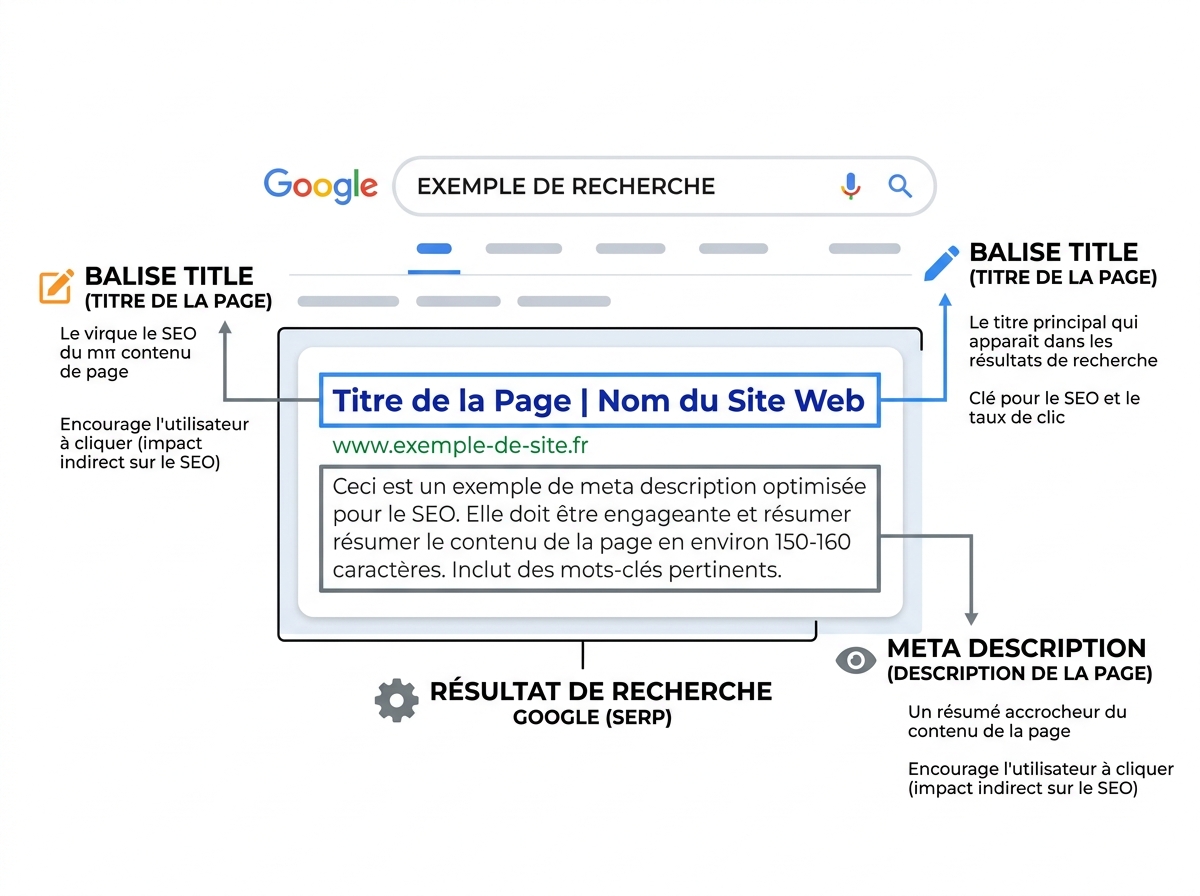
The Title tag is the clickable blue title in search results. The meta description is the grey text below it. Together, they form your snippet — what the user sees before deciding whether or not to click.
These two elements are your shop window in the SERPs. Yet, most SMEs leave them empty, generic, or copied and pasted from one page to another. The result: Google rewrites them itself, often poorly, and your competitors reap the clicks instead of you.
A clear definition: the Title tag is an HTML tag (<title>) that tells search engines and users the main subject of a page. It appears in the browser tab, in the SERPs, and when shared on social media.
Why CTR is as critical an issue as ranking
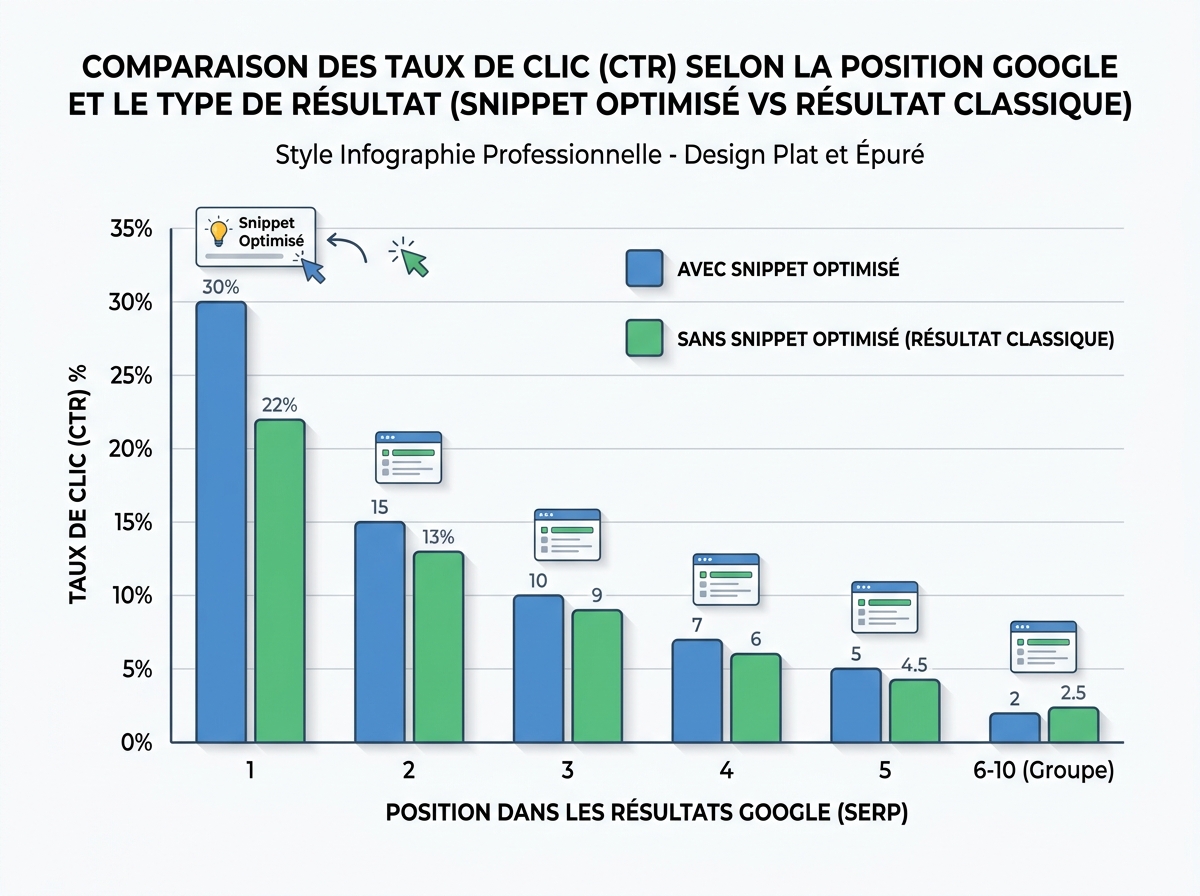
Many business owners focus on Google position. But being in position 1 with a mediocre snippet means letting qualified traffic slip away. The 2026 data is clear:
- Position 1 with optimised snippet: average CTR of 42.9% (SE Ranking, 2026)
- Position 1 without optimisation: CTR of 27.6% — a loss of 15 points
- The top 3 results capture approximately 70% of total clicks
- An optimised meta description boosts CTR by +43% (MyLittleBigWeb, 2026)
In other words: two sites in the same position can have radically different performances depending on the quality of their snippet. It's a free, immediate acquisition lever that is largely ignored.
The Title tag: the rules that make a difference

An effective Title tag adheres to a few non-negotiable principles.
Length: between 40 and 60 characters. Below that, you're wasting space. Above that, Google truncates it and your message is cut off. Tools like Screaming Frog allow you to audit your titles in bulk — but they require technical know-how and don't provide actionable recommendations for SMEs. This is precisely what a technical SEO audit tailored to your context covers.
Keyword placement: at the beginning of the title. Google and users read from left to right. A keyword at the end of the title loses perceived relevance.
Absolute uniqueness: each page must have a different Title tag. Duplicate titles are one of the most frequent — and most penalising — errors found during audits.
Before / after: a concrete example
Version | Title Tag |
|---|---|
❌ Before | |
✅ After | |
The "after" version places the profession and geographical area at the beginning, adds a concrete benefit (fast intervention), and a signal of availability. Result: a significantly higher CTR for a local query.
The meta description: your pitch in 150 characters
The meta description is not a direct ranking factor. Google has confirmed this for years. But it massively influences CTR — and therefore indirectly your traffic and conversions.
Its role: to convince the user in one sentence that your page exactly answers their question. It's a mini-sales pitch, not a page summary.
Rules to follow:
- Maximum 150 characters (approximately 920 pixels on desktop)
- Include the main keyword: Google bolds it in the SERPs, which attracts the eye
- End with a call to action: "Discover", "Get", "Compare", "Download"
- Address search intent: informational, transactional, or navigational
An absent or overly generic meta description forces Google to extract a passage from your page itself — often not very engaging. You lose control of your message.
The 4 errors that sabotage your tags (and that we see everywhere)
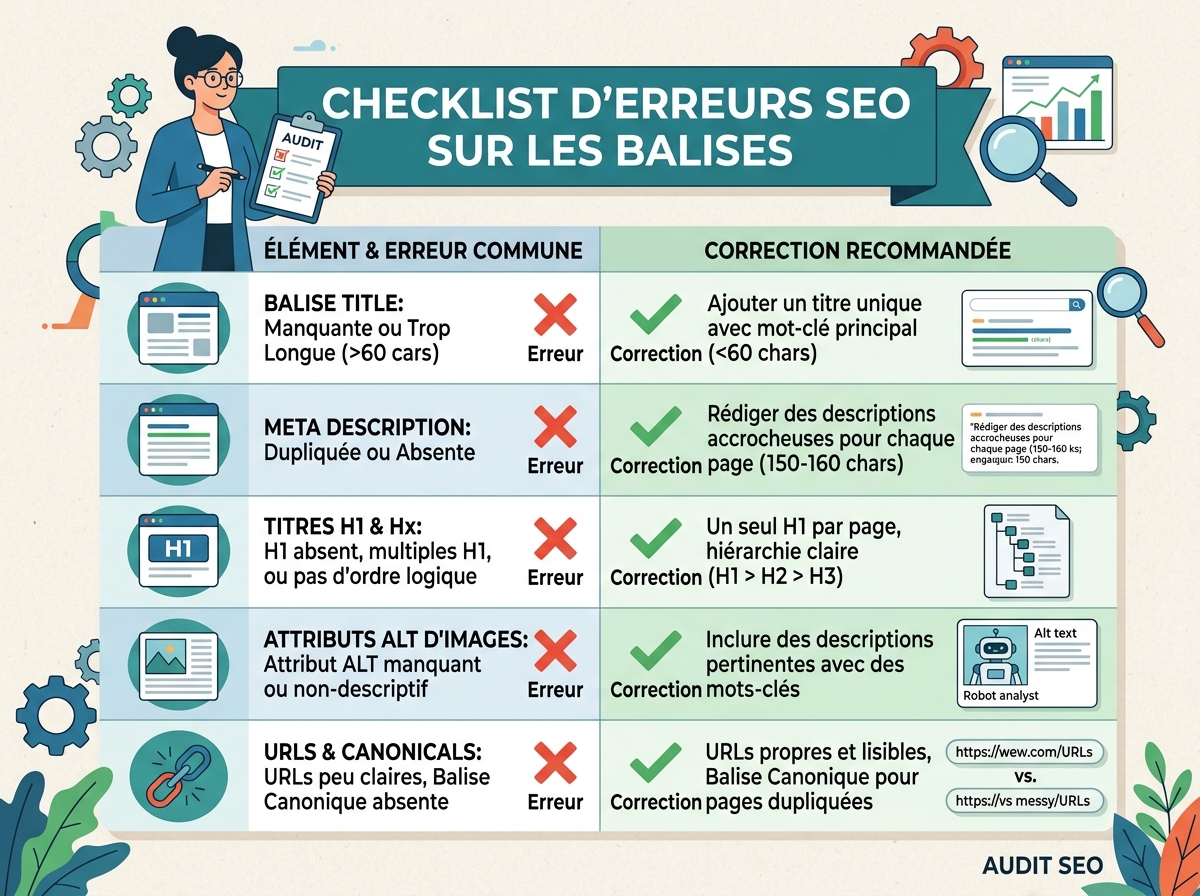
After hundreds of SME website audits, here are the most common errors:
- Duplicate Title tags: two pages with the same title send a confusing signal to Google. Frequent on e-commerce sites or sites with many category pages.
- Missing meta descriptions: Google then improvises an excerpt — rarely optimal for CTR.
- Incorrect lengths: a 90-character title will be truncated. A 50-character meta leaves unused space.
- No benefit or call to action: "Welcome to our site" doesn't encourage anyone to click. "Free quote in 2 minutes" does.
These errors are invisible from your site — they only appear in audit tools or Search Console. This is why a 360° visibility audit allows them to be identified and prioritised quickly.
Tags and AI: an issue beyond Google
In 2026, optimising your tags is no longer limited to Google. AI agents — ChatGPT, Perplexity, Gemini — read and index your pages to answer user questions. Your Title tag and meta description contribute to your site's entity reputation: they signal to these systems who you are, what you do, and for whom.
A page with a clear Title tag and a structured meta description is much more likely to be cited in an AI response than a page with a vague or generic snippet. This is the principle of GEO (Generative Engine Optimization): being visible not only in classic results, but also in AI-generated responses.
Concretely: if a user asks ChatGPT "who is the best plumber in Paris 15?", pages whose tags clearly signal their speciality, area, and added value have a structural advantage. This is no longer theory — it is already observable in LLM citations.
How to take action this week
No need for a 6-month project. Here's a 4-step method to get started:
- Audit the existing: open Google Search Console, filter pages with the lowest CTR despite a good position. These are your first targets.
- Identify duplicates: a
site:yourdomain.comsearch in Google often reveals identical titles on multiple pages. - Prioritise rewriting high-potential pages: service pages, homepage, best-ranked blog posts.
- Measure the impact: wait 4 to 6 weeks and compare the before/after CTR in Search Console.
If you lack the time or resources to conduct this audit internally, a semantic SEO audit can precisely identify which pages to prioritise for optimisation and produce directly actionable recommendations — without technical jargon.
Your Title tags and meta descriptions are perhaps the only elements of your site that your prospects see before deciding to trust you. It's worth taking care of them. Launch a free audit to find out exactly where you stand.