

You're posting on social media, your website is live, you even ordered an SEO audit six months ago. Yet, the phone isn't ringing any more than it used to. It's not a budget problem: it's a framework problem.
Visibility without strategy is just noise
The majority of French SMEs invest time and money in their digital presence — but in a fragmented way. A LinkedIn post here, a website redesign there, a few keywords worked on occasionally. The result: actions that coexist without reinforcing each other.
According to the 2024 France Num Barometer, over 60% of VSEs/SMEs report having a website, but less than a third actually measure the impact of their digital actions. Being present is not the same as being visible. And being visible is not the same as being chosen.
The first reflex to change: stop treating visibility as a checkbox, and start treating it as a system.
The 4 traps that neutralise your efforts

Before trying to do more, you need to identify what's blocking you. In practice, four errors consistently recur among stagnant SMEs.
1. Channel dispersion
Managing a website, Instagram, Google Business Profile, LinkedIn, and a newsletter simultaneously with a two-person team guarantees that everything will be done halfway. Dispersion dilutes impact. One mastered channel is better than a ghost presence on five platforms.
2. Content disconnected from purchase intent
Publishing for the sake of publishing is useless. A blog post explaining "how your business works" attracts curious people, not buyers. Effective content answers the questions your prospects ask when they are looking for a solution — not before, not after.
3. Total lack of measurement
Without clear indicators, it's impossible to know what works. Many SME leaders manage their visibility by instinct: "we feel like it's working better". This is insufficient. A minimal dashboard — traffic, leads generated, conversion rate — radically changes decision-making.
4. Visibility without conversion
This is the most costly trap. You attract traffic, but your site doesn't convert: no clear call to action, buried contact form, vague value proposition. Every visitor who leaves without acting is a lost prospect.
The game-changing framework: be visible → be chosen → capture demand
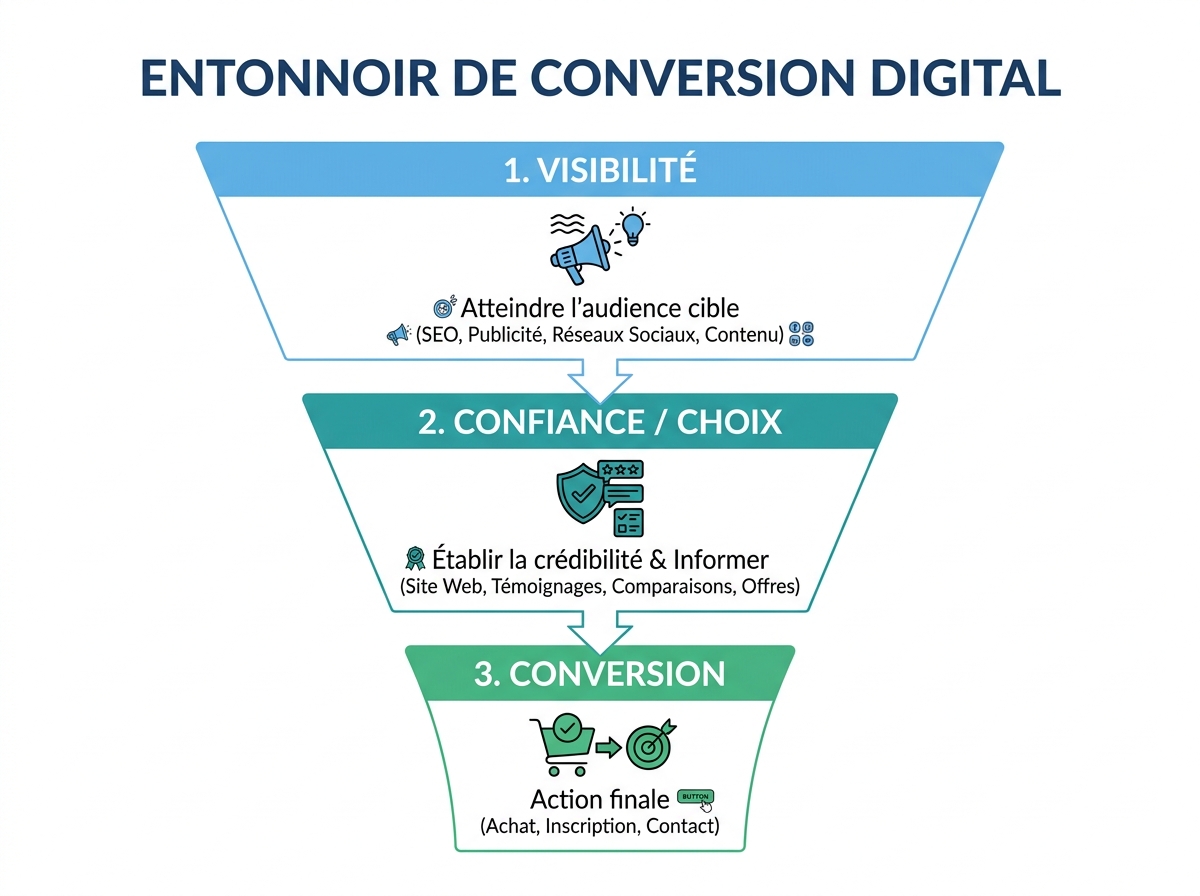
This isn't a slogan: it's an architecture. SMEs that achieve sustainable results have understood that digital visibility works as a sequential funnel, and that each step must be built before moving on to the next.
Being visible means appearing where your prospects are looking: Google, Google Maps, comparison sites, and now AI assistant responses like ChatGPT or Gemini. If your business isn't mentioned in these environments, you don't exist for a growing part of your market.
Being chosen assumes that, once found, you convince. Customer reviews, e-reputation, message consistency, social proof — this is where preference is decided. A prospect comparing you to three competitors will choose the one that inspires the most trust, not necessarily the cheapest.
Capturing demand is the final step: transforming interest into action. Call, form, quote request, purchase. This is where ROI becomes measurable — and it's often where SMEs abandon the work too early.
Prioritise rather than multiply

The good news: you don't have to do everything. You need to do the right things in the right order.
A local SME that wants to generate qualified leads should, in order:
- Optimise its Google Business Profile listing — it's free, fast, and directly linked to local searches with strong purchase intent.
- Fix technical blockages on its site — loading time, mobile, essential tags. A slow site loses an average of 53% of its mobile visitors before they even read a line (source: Google/SOASTA).
- Produce 3 to 5 pages or articles aligned with transactional queries — not generic content, but precise answers to your potential buyers' questions.
- Set up minimal tracking — Google Analytics 4, Search Console, and a configured conversion goal. Without this, you're navigating blind.
- Activate a complementary acquisition channel — targeted SEA, local campaign, or partnerships — only once the foundations are laid.
This sequence seems obvious. Yet, it is rarely applied in this order.
Measure to decide, not to reassure
Measurement is not a reporting exercise: it's a decision-making tool. Three indicators are enough to rigorously manage an SME's visibility.
- Qualified organic traffic: how many visitors arrive via searches related to your actual activity?
- Conversion rate: what proportion of these visitors take a concrete action (call, form, purchase)?
- Acquisition cost: how much does each new customer actually cost you, across all channels?
These three figures, updated monthly, allow you to arbitrate: double down on what works, cut what produces nothing. Tools like Google Search Console or GA4 provide access to this data for free — but interpreting it correctly requires expert reading.
This is where many SME leaders stop: the data is there, but the meaning escapes them. Some turn to tools like Semrush or Ahrefs, powerful but designed for experienced marketing teams, with subscriptions often exceeding €100/month without support. For an SME, this is rarely the right entry point.
What AI changes (and what it doesn't)
Since 2024, a new dimension has been added: Google's AI Overviews, ChatGPT, Perplexity, and Gemini directly answer user questions — citing some businesses, ignoring others. This phenomenon, known as GEO (Generative Engine Optimization), redefines what "being visible" means.
An SME whose content is well-structured, factual, and aligned with precise questions now has a chance to be cited by an AI assistant in a response to a prospect. Those that publish vague or generic content disappear from these new visibility spaces.
The good news: the fundamentals remain the same. Quality content, clear structure, domain authority, entity consistency. What changes is the urgency of applying them — because the delay quickly widens.
Where to start concretely?
If you're reading this article and recognise yourself in the traps described, the first step isn't to launch a new campaign. It's to conduct an honest assessment of your current visibility.
What really works? Where are you losing prospects? Which channels deserve to be strengthened, which should be abandoned?
This initial audit is exactly what Digitalyser offers with its 360° visibility audit: a complete analysis of your digital presence — SEO, local, reputation, technical — to identify priority levers, not an exhaustive list of everything that could be improved.
If you prefer to start by getting an idea, a free audit is available directly online. And if you want to go further in your acquisition strategy, Digitalyser's SEO and acquisition services are designed for SMEs that want measurable results, not just reports.
Visibility that pays off is built. But it starts with knowing where you really stand.