


You have a website, social media profiles, maybe even a newsletter — and yet the results aren't following. According to the Baromètre France Num 2024, 85% of French VSEs/SMEs have at least one online visibility solution, but only 56% get more than 5% of their customers through digital channels. The gap between presence and performance has a name: the absence of strategy.
Online Presence ≠ Communication Strategy

A communication strategy is a structured plan that defines who you're talking to, what to say, on which channels, and with what measurable objective. Without it, your website and social media are just empty shop windows.
The confusion is common: many entrepreneurs think that creating an Instagram account or publishing a blog post constitutes a strategy. This is the equivalent of opening a shop without a sign, without layout, and without trained sales staff. You are present, but no one knows why they should enter.
The concrete result on the ground? Irregular posts, a tone that changes from one post to another, a website that talks about you rather than your customers — and a budget spent without measurable return.
The 3 Mistakes That Sabotage Your Communication From the Start

Mistake 1: Acting Without a Defined Objective
Publishing to "be visible" is not an objective. An objective is formulated as follows: "Generate 20 quote requests per month via my website within 90 days." Without this precision, you can neither manage your actions nor measure their effectiveness.
Mistake 2: Ignoring Audience Segmentation
Your message cannot be for everyone. A plumber in Île-de-France and an online fashion boutique do not have the same customers, the same codes, or the same relevant channels. According to HubSpot, 82% of marketing teams who succeed in their content strategy do so thanks to a deep understanding of their target audience.
Mistake 3: Neglecting Brand Consistency
A logo on LinkedIn, a familiar tone on Instagram, a cold corporate website — this lack of consistency blurs your image and erodes trust. Prospects who discover you on multiple channels should immediately recognise your identity.
How to Build an Effective Communication Strategy in 5 Steps
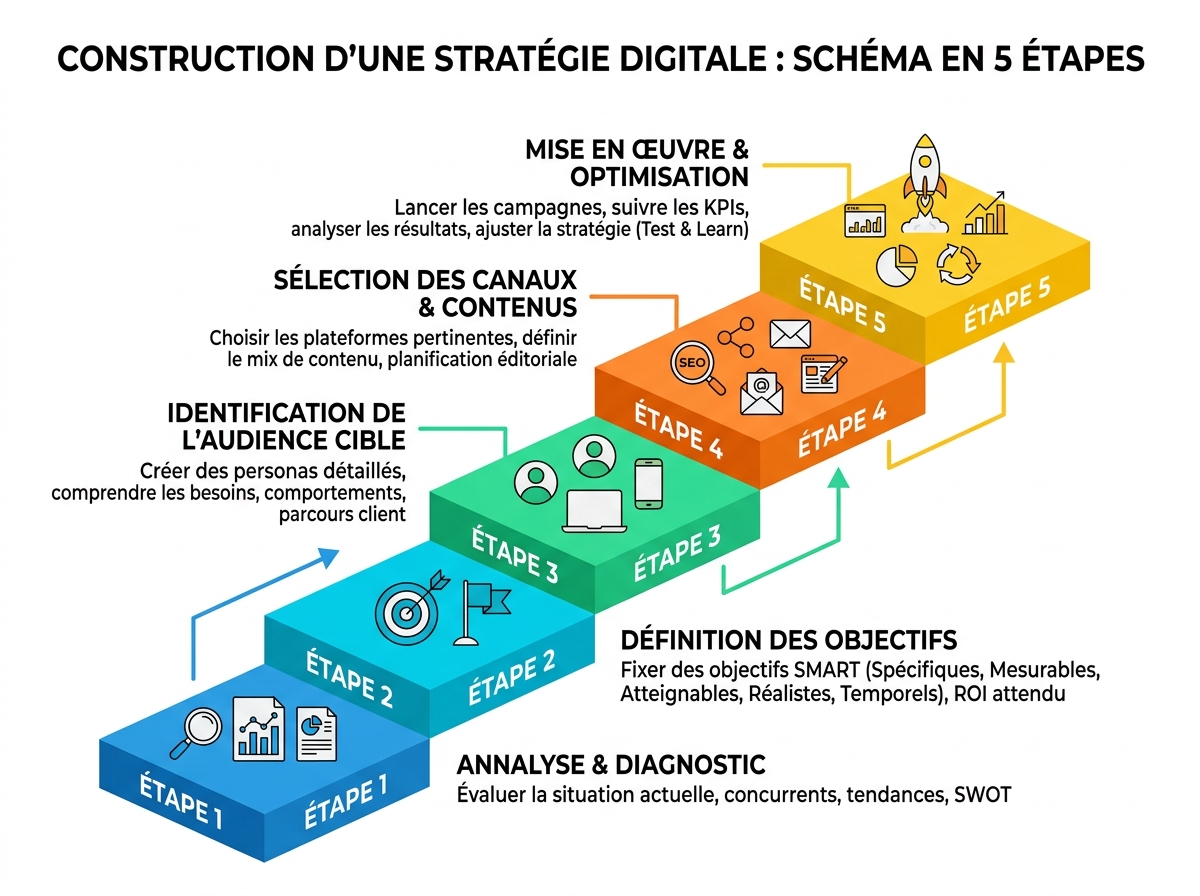
Here's the method we apply at Digitalyser to support SMEs, from diagnosis to execution.
Step 1 — Set SMART Objectives Awareness, lead generation, customer loyalty, direct sales: each objective implies different channels and formats. Define 1 to 2 priority objectives for the next 3 months.
Step 2 — Map Your Audience Create 2 to 3 personas: who are they, what problems are they trying to solve, where do they spend time online? This step conditions everything else.
Step 3 — Define Your Positioning and Tone What is your unique promise? Are you the reassuring expert, the accessible innovator, the niche specialist? Your tone must be consistent across all media — from the quote to the Instagram story.
Step 4 — Choose the Right Channels (and Eliminate Others) It's better to excel on 2 channels than to be mediocre on 5. For a local B2B SME, LinkedIn + local SEO is often more profitable than TikTok + Pinterest. For an e-commerce shop, Instagram + Google Shopping may suffice. The choice depends on your audience, not trends.
Step 5 — Plan and Measure with an Editorial Calendar Regularity beats sporadic intensity. A simple editorial calendar — even on a spreadsheet — allows you to maintain momentum, anticipate key moments, and measure what works. According to HubSpot, 74% of marketers who achieve their lead generation goals do so through a structured content strategy.
Content: Driver or Brake Depending on How You Use It
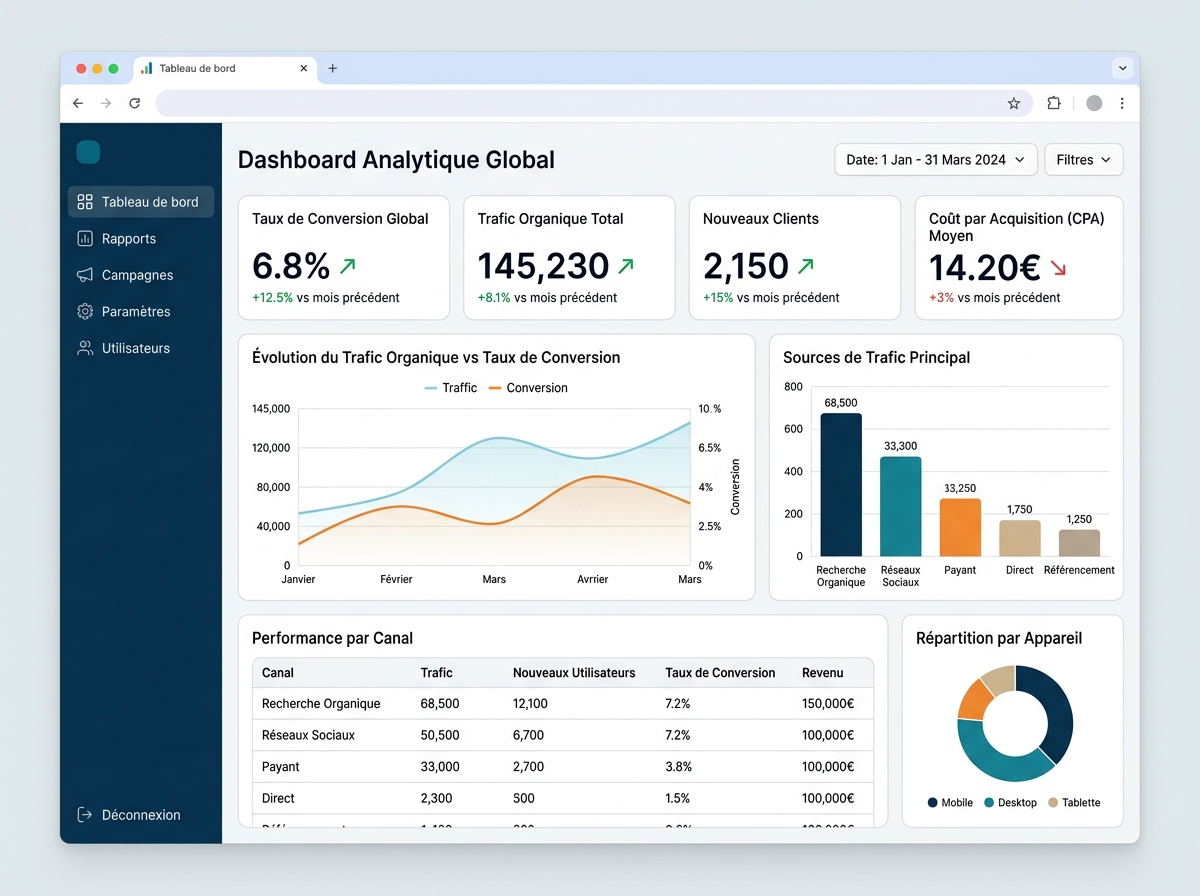
Content is often presented as the miracle solution. In reality, content without strategy amplifies the problem: you produce more, but you reach fewer of the right people.
A blog post that answers a real question from your prospects is infinitely more valuable than ten generic posts about your industry. The golden rule: every piece of content must serve a specific objective (inform, reassure, convert) and target an identified persona.
Also consider AI visibility: by 2026, ChatGPT, Gemini, and Perplexity will directly answer your prospects' questions. If your content is not structured to be cited by these agents, you are missing out on a growing part of the demand. This is called GEO (Generative Engine Optimization) — a lever that pioneering SMEs are already integrating into their editorial strategy.
Measure to Correct: The Metrics That Really Matter
Many SMEs measure the wrong metrics: the number of "likes" or followers. These vanity metrics do not reflect the health of your communication.
Prioritise these actionable KPIs:
- Conversion rate of visitors to leads (form, call, quote)
- Real engagement rate (comments, shares, clicks) vs reach
- Organic traffic and positioning on your target keywords
- Cost per lead if you invest in advertising
- Return rate to your site (sign of loyalty)
Without this data, you are navigating blindly. A 360° visibility audit precisely identifies where your communication is losing effectiveness — before you spend more.
Tools and Support: What SMEs Often Get Wrong
Faced with complexity, many leaders turn to tools like Semrush, HubSpot, or Hootsuite. These platforms are powerful — but they are designed for dedicated marketing teams, with significant budgets and a steep learning curve. For an SME without internal resources, they quickly become time-consuming and underutilised.
The alternative: start with a clear diagnosis of your current situation, then act on priority levers. This is Digitalyser's approach: identify what is hindering your visibility, correct the fundamentals, then amplify what works — without drowning you in complex dashboards.
A well-constructed SEO strategy and a consistent online presence are the two pillars on which everything else rests. If one of the two is deficient, all your content and advertising efforts will produce results below their potential.
Where to Start Concretely?
If you are reading this article, it is probably because you feel that something is not working — but you can't quite put your finger on it. This is exactly the right time to take stock.
Start by answering these 3 questions:
- What is my main objective for the next 90 days (awareness, leads, sales)?
- Who is my ideal customer and where do they look for solutions like mine?
- Which channels do I truly master and which ones do I manage out of obligation without conviction?
These answers outline the contours of your strategy. If you want to go faster and avoid common mistakes, a free audit will give you a clear vision of your current situation and the priorities to address first.