


900 million people query ChatGPT every week. A growing proportion of your potential customers are asking an AI their questions even before opening Google. If your brand doesn't appear in these answers, you simply don't exist to them.
The silent shift in search behaviour
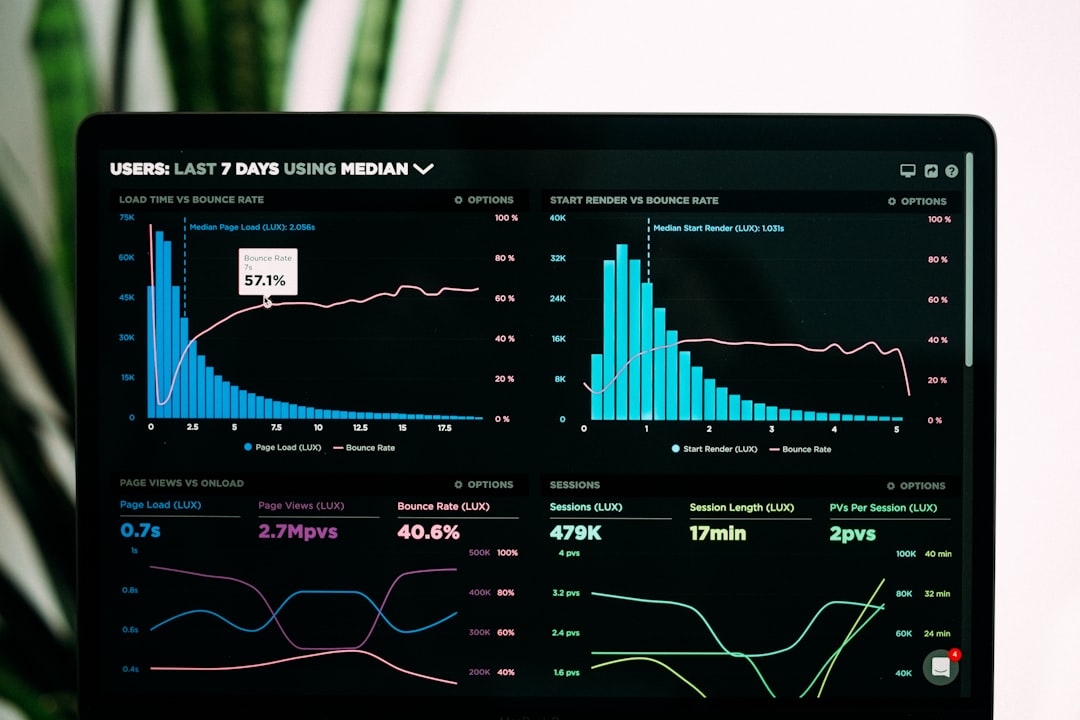
The disruption is already here, quantified and documented. In June 2025, referral traffic generated by conversational AIs had jumped by +357% in one year (source: oscar-referencement.com, Similarweb data). Today, Google AI Overviews reaches 2 billion users per month, ChatGPT exceeds 900 million weekly users, and Perplexity has 45 million active users.
This isn't just a phenomenon for tech enthusiasts. In France, 44% of the active population already uses ChatGPT (Médiamétrie/Sortlist, early 2026), and 32% of French SMEs and mid-caps are integrating it into their processes. Your B2B clients, your local buyers, your prospects — they're asking an AI questions and expecting a direct answer, not ten blue links to sort through.
Behaviour has changed: we no longer search, we ask.
What it means to be absent from AI answers

When a buyer types "which HR provider to choose in Lyon" into ChatGPT, the AI doesn't list search engine results. It synthesises, selects, and cites. If your company isn't in its knowledge base — because your content is too thin, too poorly structured, or too rarely shared — you won't be mentioned.
The impact on conversion is direct. Visitors arriving via ChatGPT convert at 15.9%, nine times more than organic Google traffic (1.76%). Perplexity generates 10.5% conversion, Gemini 6.8%. These audiences are highly qualified because they've already received an answer — and they're now looking to act.
Conversely, with Google's AI Overviews, the organic CTR drops to 0.61% (compared to 1.76% without AI) and the zero-click rate rises to 83%. Being absent from the AI answer means losing almost all visibility for these queries.
What is GEO (Generative Engine Optimization)?
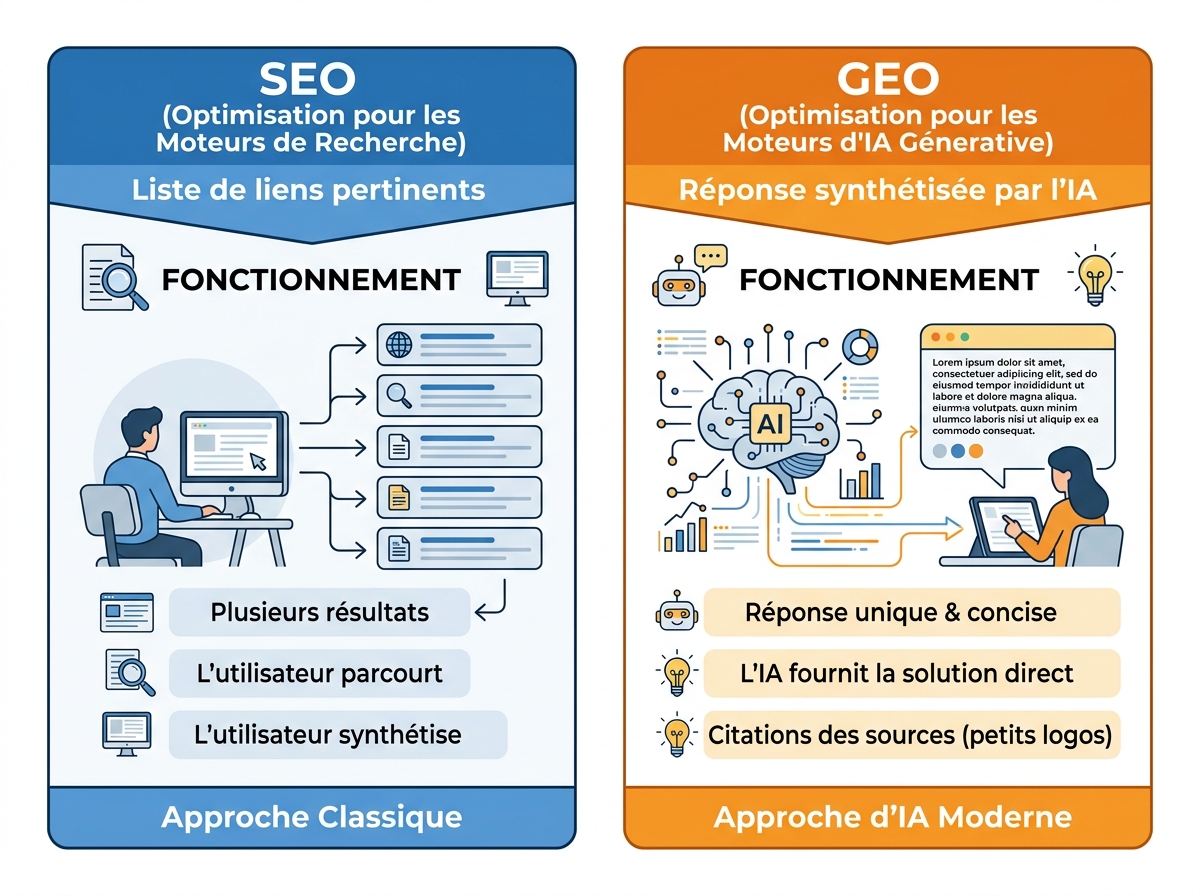
GEO (Generative Engine Optimization) is the set of practices aimed at making a brand, service, or content citable and recommendable by generative search engines — ChatGPT, Gemini, Perplexity, Claude, and Google's AI Overviews.
It doesn't replace SEO: it extends it. Where classic SEO optimises for ranking in a list of links, GEO optimises for inclusion in a synthesised answer. The signals are not identical:
- Domain authority: sites with a DA > 60 are systematically cited by LLMs.
- Named entity density: highly cited content contains 20.6% named entities, compared to 5-8% for standard text.
- Factual data consistency: name, address, sector, specialities — this information must be identical across all touchpoints.
- Freshness and structure: AIs favour recent content that is well-tagged (headings, lists, self-contained definitions).
An SME that works on its GEO isn't playing in a parallel world: it simultaneously strengthens its SEO, its entity reputation, and its visibility in AI answers.
How to check if your brand is cited by AIs
Before optimising, you need to measure. The diagnosis is simple to start, even without specialised tools.
10-minute manual test:
- Open ChatGPT, Gemini, and Perplexity.
- Ask questions your customers actually ask: "Which [your sector] do you recommend in [your city]?", "What are the best [your service] for an SME?"
- Note whether your brand is cited, whether it's described correctly, and whether the information matches your current reality.
If you don't appear in all three answers, you have a visibility blind spot. If you appear but with incorrect or incomplete information, it's an entity consistency problem — potentially more serious, as the AI is actively spreading a false image of you.
Tools like Semrush or Ahrefs are starting to integrate AI tracking modules, but they are still designed for large organisations: expensive, complex, with a real learning curve. For an SME, the Digitalyser 360° visibility audit is designed to precisely measure this AI presence without requiring prior technical expertise.
The first GEO levers to activate for an SME

No need to redo everything. Four levers concentrate most of the impact.
1. Structure your content for AIs
LLMs learn from well-organised texts. Every page of your site should answer a specific question from the first sentence, include self-contained definitions ("X is..."), and use descriptive headings. An article that starts with the answer, then elaborates, is infinitely more citable than an article that "sets the scene" for three paragraphs.
2. Unify your entities across all channels
Your brand entity — the data node that represents you in the AI knowledge graph — is built from the consistency of your information. Identical name everywhere, standardised address, precise business sector, consistent description on Google Business Profile, LinkedIn, industry directories, website. An inconsistency between these sources creates noise and reduces LLM trust.
3. Produce citable factual data
AIs cite what they can verify. Internal studies, field figures, structured customer testimonials, documented use cases: this type of content is exactly what LLMs seek to integrate into their answers. A blog post with a sourced statistic is worth ten times more than a generic article on "the benefits of our service."
4. Build a consistent and regular presence
Frequency matters. AIs update their knowledge and favour active sources. Publishing regularly — even modestly — on your website, your Google Business Profile, and your social networks sends a signal of vitality that generative engines integrate. This is one of the pillars of the SEO and content strategy we deploy for SMEs.
GEO and SEO: two complementary, not opposing, disciplines
A common mistake is to oppose GEO and SEO. In reality, the foundations are common: quality content, domain authority, data consistency. What changes is the purpose.
SEO aims to appear in a list of links. GEO aims to be the answer. The two objectives reinforce each other: a site well-optimised for SEO provides the authority signals that LLMs need; content well-structured for GEO improves time on page and behavioural signals that feed into SEO.
The real question isn't "SEO or GEO?" but "does my content deserve to be cited?". If the answer is no, neither Google nor ChatGPT will help you.
Where to start concretely?
The most effective starting point is an honest assessment. Before investing in content or restructuring your site, you need to know where you stand: are you cited? Correctly? For which queries? With what entity consistency?
This is exactly what the Digitalyser 360° visibility audit measures: presence in AI answers, entity consistency, SEO signals, online reputation — all in an actionable diagnosis, without technical jargon.
SMEs that make this shift now have a real head start. In 18 months, GEO will be as essential as local SEO is today. The question isn't whether your customers use AIs to search — they already do. The question is: does the AI speak well of them, or not speak of you at all?
If you want to find out, start your free audit — it takes less than two minutes.