

An audit that lists eighty findings does not sell and does not get executed. Here is the method that produces a document a client understands, arbitrates and pays for — and whose effect you can prove six weeks later.
Why an exhaustive audit triggers nothing
The first audit you deliver to a client is rarely judged on its accuracy. It is judged on what it triggers. A forty-page document, technically flawless, ending in a list of eighty recommendations, triggers nothing: the client reads it, finds it impressive, files it, and calls you six months later about something else.
The cause is almost never a failure of analysis. It is a failure of order.
An executable audit answers three questions, in this strict order: where do we stand, what weighs most, and how will we know it worked. Anything that serves none of those three makes the document heavier without making it more useful.
Question 1 — where do we stand

This means covering the whole surface, because stalled visibility rarely has a single cause, and the real cause often sits outside the scope you planned to audit. A client convinced they have a content problem frequently has an indexing problem; a client convinced they have a local search problem frequently has a reviews problem.
The eight surfaces to cover
- Local visibility: business listing, local citations, information consistency from one platform to the next
- Reputation: review volume and freshness, split by source, sentiment, replies given
- Online presence: social networks, directories, sector platforms where the business should appear
- Content: coverage of search intents, quality per page, pages to merge or drop
- Technical SEO: indexability, redirects, canonicals, heading hierarchy, structured data, orphan pages
- Analytics and measurement: is measurement in place, is it reliable, does it allow any conclusion at all
- Discoverability by AI assistants: is the brand cited, on which queries, and who is cited instead
- Competition: who actually appears on the client’s queries, not who the client believes their competitor is
The competitor list a client gives you is almost always wrong
It lists commercial rivals — businesses they meet in the field. That is not the same as the entities occupying the results on their queries. Auditing against the wrong list produces a reassuring, false benchmark.
Build the list from the search results, by recurrence: an entity that comes back across many of the client’s queries is a visibility competitor, whether or not it is a commercial one.
Question 2 — what weighs most
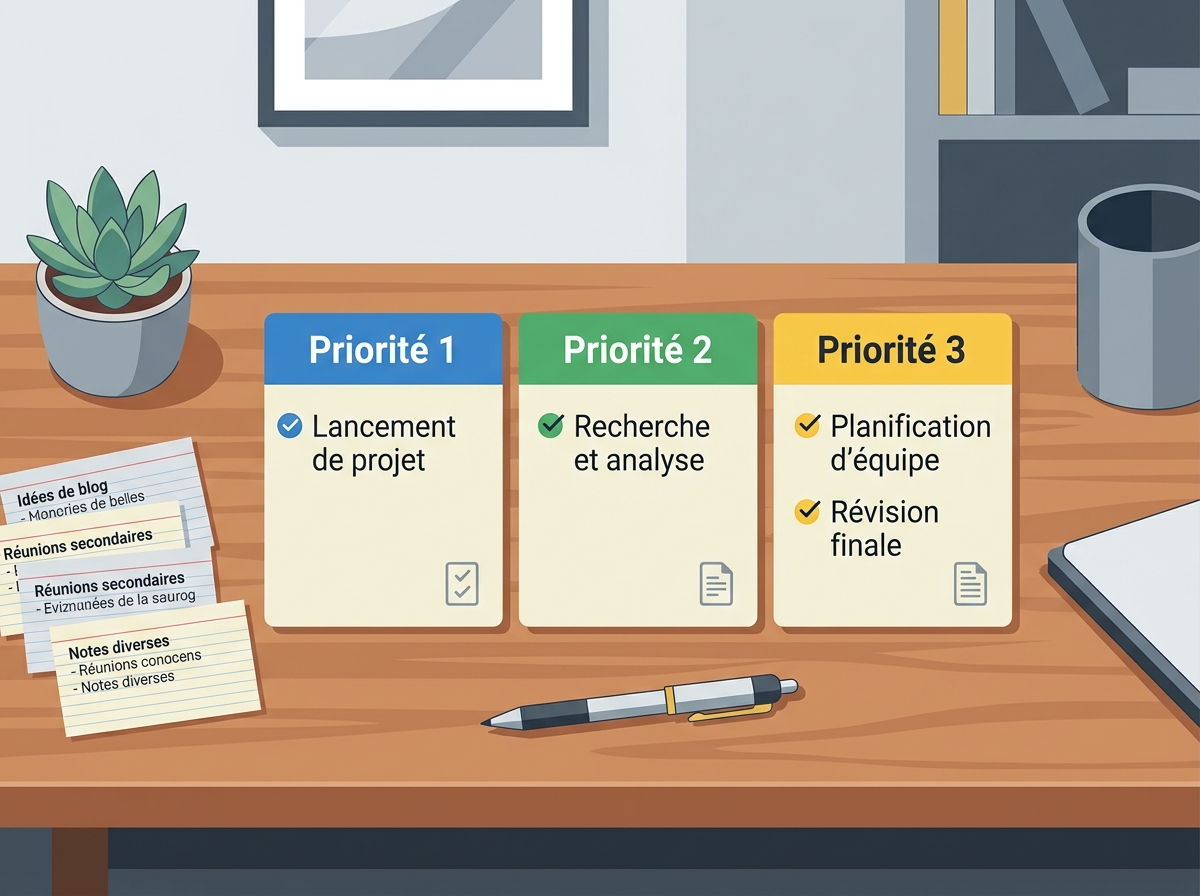
This is where most audits fail, because prioritising means giving things up. A recommendation marked « important » without being ranked against the others is not a priority, it is an opinion.
If your document does not let the client say « I am doing these three things this quarter and leaving the rest », it has not prioritised.
The useful criterion is not technical severity but the expected effect on the business. An indexing fault on a page that would receive no searches anyway is technically serious and commercially worthless. A lack of recent reviews on a listing that already surfaces in the local pack can be worth ten times more, for a tenth of the effort.
What the client should be able to recite from memory
- Three priorities at most for the quarter, ordered, with the expected effect of each
- For each priority, who does what — you, their team, or a third party
- The baseline measurement taken before any correction
- What was deliberately set aside, and why — that is what proves you arbitrated
- A re-measurement date, fixed in advance, not « we’ll have a look »
Question 3 — how will we know it worked
This is handled at the start, never at the end. The baseline is taken before the first correction, otherwise it no longer exists: once the corrections are through, the prior state cannot be reconstructed, and the next audit ends with « it seems better ». A client who paid for work deserves better than an impression.
Set the observation window according to the lever. An indexing fix shows within days. A completed listing takes two to four weeks. Content work is judged over a quarter.
Announcing the right window in advance spares you the most painful conversation in this trade: the one where the client asks for results three days later.
The real cost of a manual audit

An audit of this breadth takes an experienced consultant between one and three days per client, most of it collection: opening tools, copying figures, checking consistency. It is the least skilled work of the engagement and the most expensive.
It is also what scales worst: what holds for three clients no longer holds for thirty. Automating the collection does not replace arbitration — the opposite: the value you bill shifts towards arbitration, which is what the client cannot do alone.