

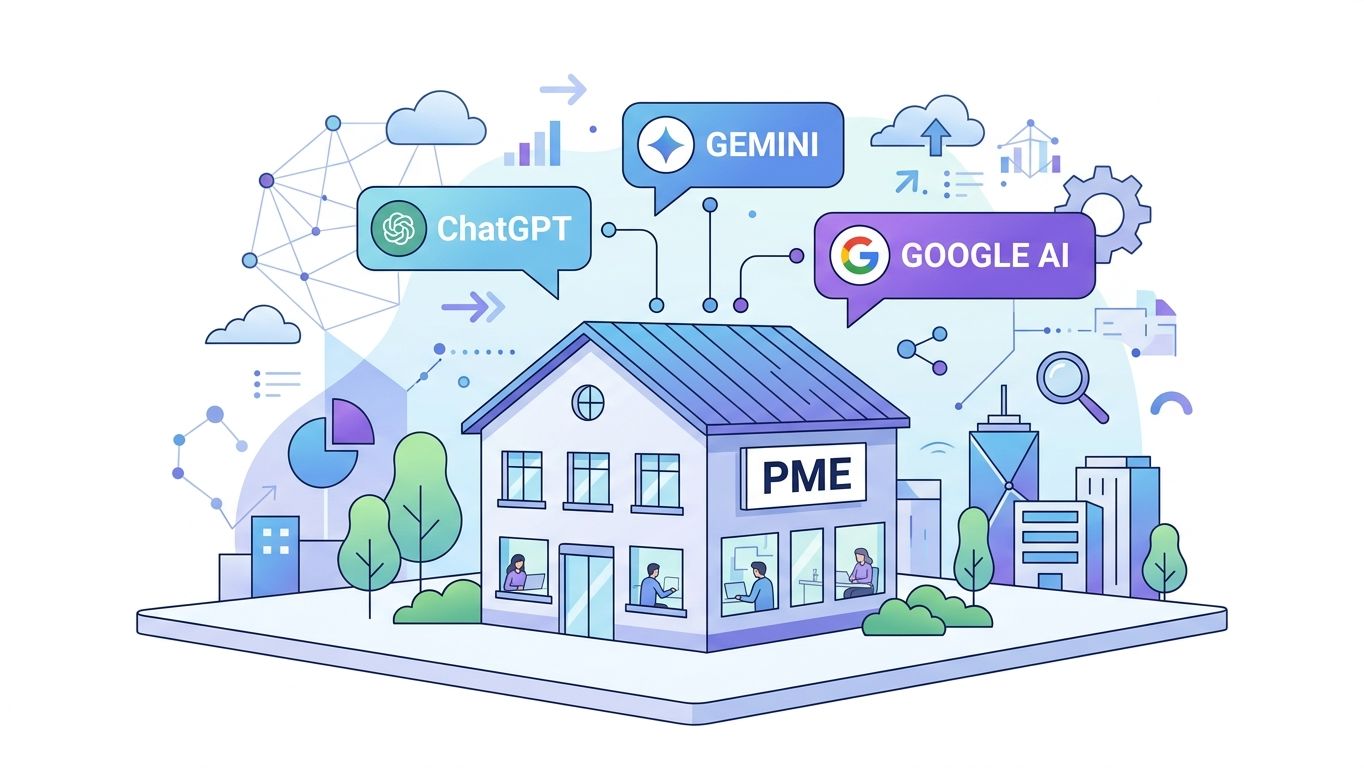
Every day, ChatGPT drives traffic to over 30,000 unique domains (Semrush, 2024). Is yours one of them? While 97% of Google's AI Overviews draw their sources from the organic top 20 (seoClarity, 2025), most SMEs have yet to change anything in their content. Here's how to reverse the trend, step by step.
What AI visibility really is (and why it changes everything)
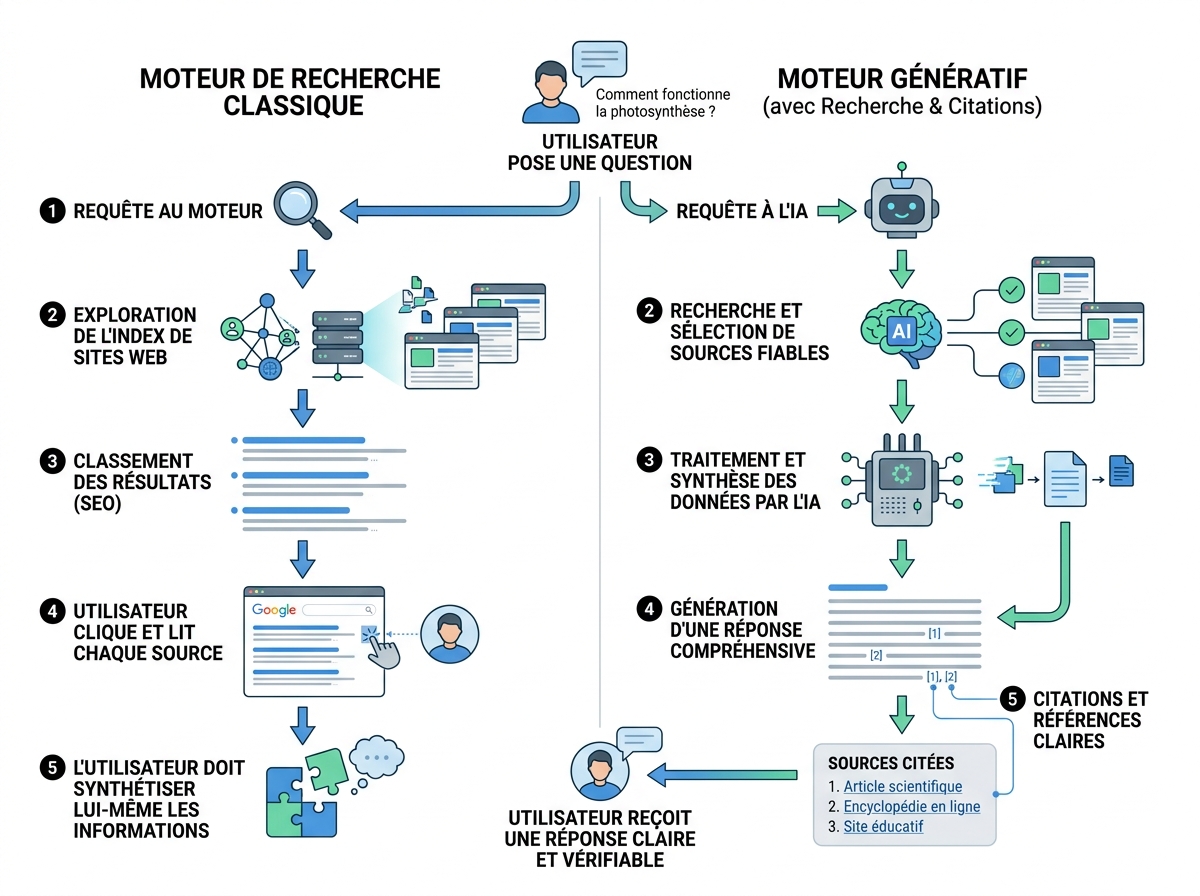
AI visibility — or GEO (Generative Engine Optimization) — refers to a content's ability to be selected, cited, or summarised by a generative engine: ChatGPT, Gemini, Perplexity, or Google's AI Overviews. This isn't classic SEO: AIs don't click, they synthesise.
In concrete terms, an internet user asks ChatGPT a question about "the best accountant in Lyon" or "how to choose an HR provider". The AI responds by citing 2 or 3 sources. If your site isn't among them, you don't exist in that answer — even if you're in position 1 on Google.
The GEO market is expected to grow from $886 million in 2024 to $7.3 billion in 2031 (Valuates Reports, 2025). This is no longer an emerging trend: it's a full-fledged acquisition channel.
Structuring your content with direct answers (answer-first)
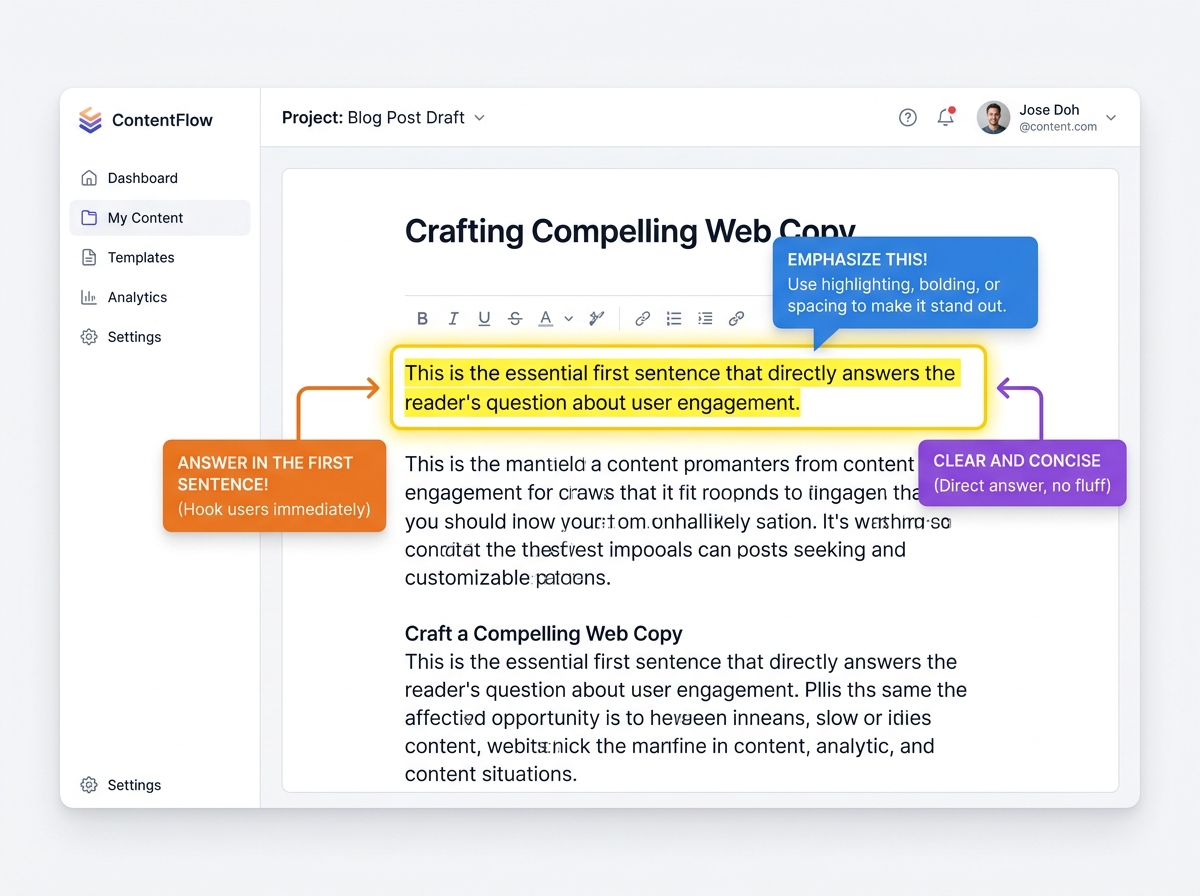
Generative AIs favour content that answers a question immediately, without preamble. This is the principle of answer-first: the answer comes in the first sentence, before any elaboration.
Concretely, instead of writing "In this article, we will explore the different ways to...", write directly: "An accountant costs between €800 and €3,000 per year for a very small business, depending on the volume of accounting documents."
The formats that work best:
- Listicles: 21.9% of AI citations (Digital Bloom, 2025)
- Informative articles: 16.7% of citations
- Q&A format: +25.45% more likely to be cited vs continuous text (Princeton University, 2024)
- HTML tables: +47% additional citations for correctly tagged tables
A simple test: reread your homepage or flagship article. If the answer to the main question doesn't appear in the first 50 words, rewrite the intro.
Integrating sourced numerical data and standalone definitions
LLMs (large language models) are trained to value factual, verifiable, and citable content. Two levers are particularly effective.
Sourced numerical data increases AI visibility by +40% when present in the content (Aggarwal et al., Princeton, 2024). Don't say "many SMEs use social media": say "74% of French SMEs are present on at least one social network (BpiFrance, 2023)".
Standalone definitions are phrases extractable out of context: "The conversion rate is the percentage of visitors who complete a target action on a website." An AI can use this phrase as is in an answer. This is exactly what you're looking for.
Also add named citations (mention of author, source, year): they improve citation visibility by +30% (Digital Bloom, 2025).
Nurturing your entities: NAP consistency and Knowledge Panel
An entity is how AIs and Google identify your business as a real and reliable player. This involves two fundamental elements.
NAP consistency (Name, Address, Phone): your business name, address, and phone number must be strictly identical on your website, Google Business Profile, LinkedIn, directories (Yellow Pages, Yelp, Tripadvisor...). A single inconsistency creates doubt for AIs about your real identity.
The Google Knowledge Panel is the information box that appears to the right of search results when you search for your brand. To obtain or enrich it:
- Claim and complete your Google Business Profile
- Create or complete a Wikidata page (accessible to all, free)
- Ensure your site clearly mentions your sector, location, and specialities
According to Yext (2025), 86% of AI citations come from sources controlled by the brands themselves — 44% of which are from the proprietary website. Your site is your primary lever.
Obtaining external mentions and citations
AIs don't just cite well-structured sites: they also cite entities recognised by other sources. This is the equivalent of link building for GEO.
Concrete actions for an SME:
- Respond to journalists via platforms like HARO (Help A Reporter Out) or Qwoted: a citation in a press article generates a quality external mention
- Publish opinion pieces or interviews in sectoral media (even local)
- Obtain Google and Trustpilot reviews: AIs are increasingly integrating reputation signals
- Be listed in specialised directories: Kompass, Societe.com, trade directories
Content cited 3 times in different sources is 3 times more likely to be picked up by an AI than isolated content (Analyzify, 2025). The dispersion of mentions matters as much as their quality.
Deploying schema.org structured data
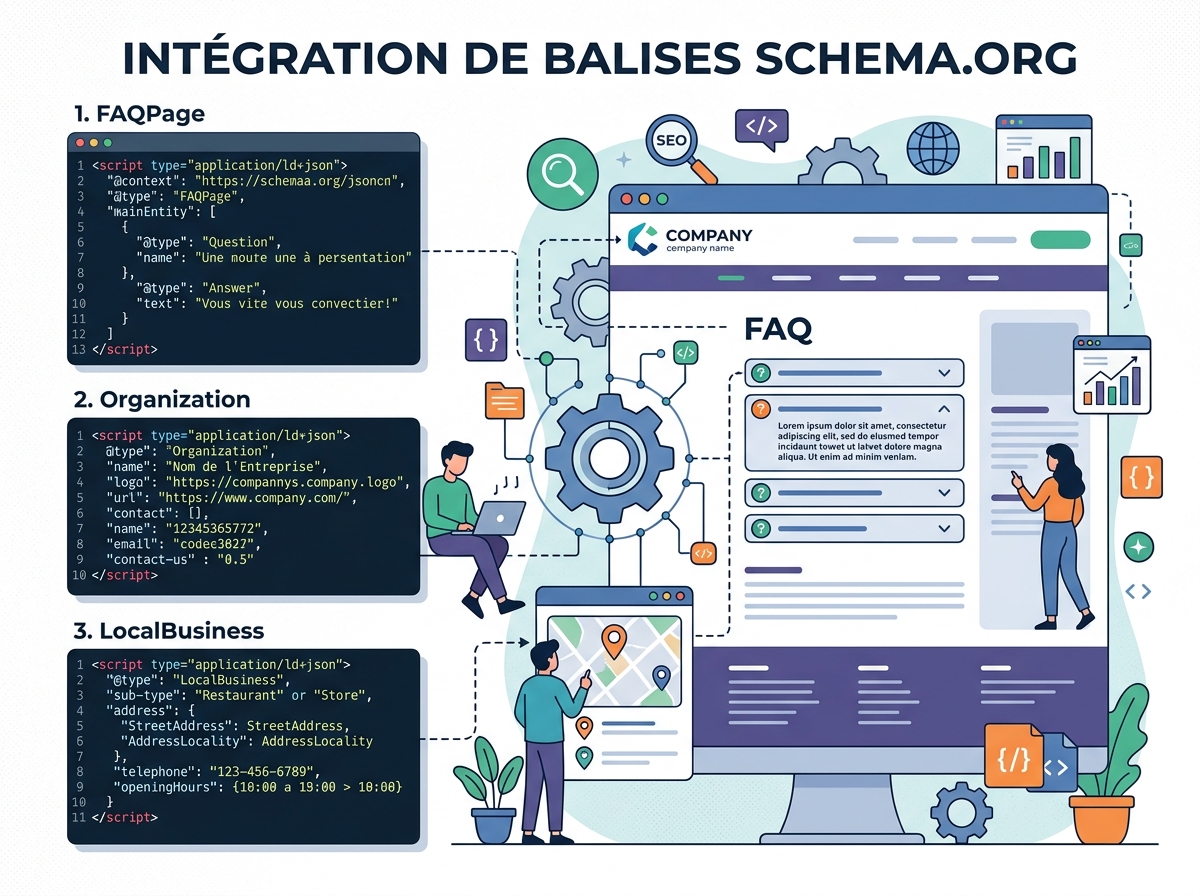
Structured data are code tags (invisible to the reader) that tell search engines and AIs the exact nature of your content: it's an FAQ, it's a product, it's a local business, it's an article.
For an SME without a technical team, here are the priority schemas:
- Organization: name, address, phone, logo, social networks — to be placed on all pages
- LocalBusiness: sector, opening hours, service area — essential for local visibility
- FAQPage: each question/answer becomes extractable by AIs
- Article: author, publication date, update date — freshness signal
Good news: most CMS (WordPress with Yoast or RankMath, Wix, Squarespace) allow you to add these tags without touching the code. A plugin is enough. Then test your implementation with Google's Rich Results Test.
LLMs explicitly favour structured, numerical, and FAQ-formatted content — this is documented by research teams at Princeton and Google DeepMind.
Answering your customers' real questions
ChatGPT, Gemini, and Perplexity are primarily question engines. To be cited, your content must answer the questions your customers actually ask — not the questions you think they ask.
How to find them?
- Google Search Console: look at the queries that trigger impressions on your site
- AnswerThePublic or AlsoAsked: map questions related to your sector
- Your own customers: note the 5 most frequent questions during your first meetings
Then create a dedicated FAQ page or integrate Q&A sections into your existing articles. Each question should have a complete answer of 40 to 80 words — precise enough to be cited, short enough to be used as is.
Avoid keyword stuffing: Princeton studies show a negative impact of -8% on AI citations for content that over-optimises its keywords. Natural density takes precedence.
Measuring and managing your AI visibility with a dedicated audit
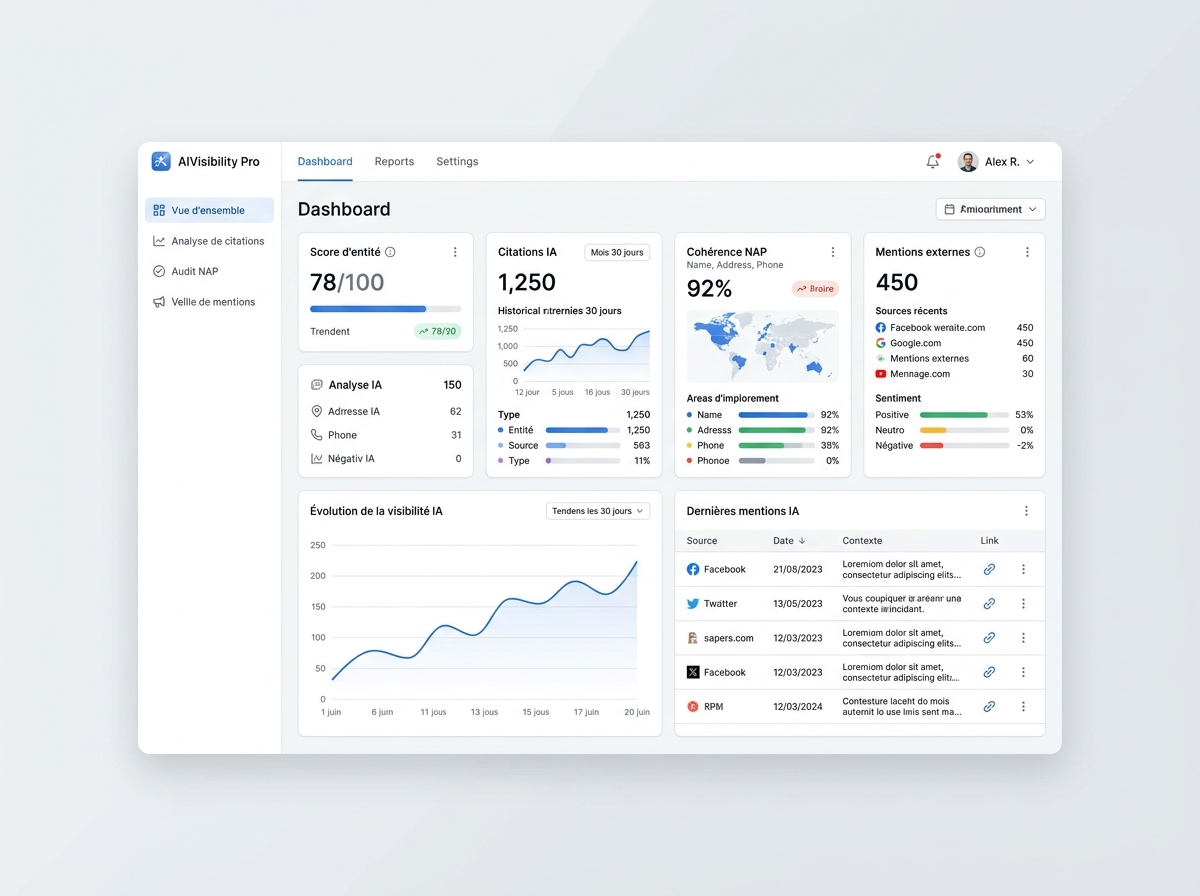
It's not enough to apply these best practices once: AI visibility evolves weekly with model updates. You need to measure to progress.
General tools like Semrush or Ahrefs remain focused on traditional SEO — Google positions, backlinks, organic traffic. They don't measure whether your brand is cited by ChatGPT, whether your Knowledge Panel is complete, or whether your entities are consistent across all your touchpoints.
This is precisely what Digitalyser's 360° visibility audit covers: analysis of your presence in AI responses, entity consistency, structured data, external mentions, online reputation. A unique dashboard, designed for SMEs without an IT department.
If you want to know where you stand today — and what you're missing to appear in ChatGPT or Gemini's answers — start with a free audit. In 10 minutes, you'll get an actionable diagnosis of your AI and local visibility.
The question is no longer whether AIs will change how your customers find you. It already has. The question is whether your content is ready to be cited.