

Asking for reviews lifts your visibility. Some ways of asking get your profile penalised. The line is written down in plain words, and it is narrower than certain practices on the market would suggest.
What Google forbids, in plain words
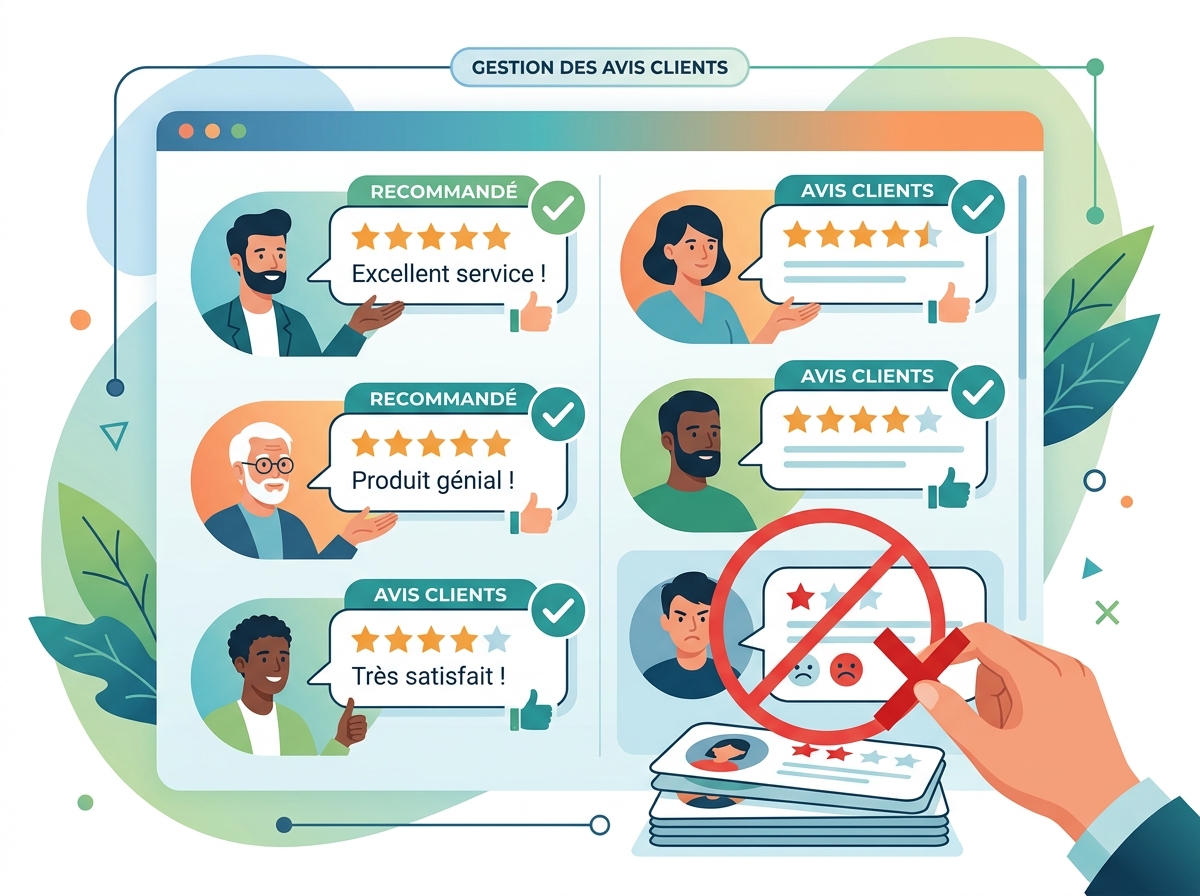
The « Prohibited & restricted content » policy for business profiles is explicit about three practices. They are not a matter of interpretation: they are named.
- Discouraging or preventing negative reviews
- Selectively soliciting positive reviews
- Offering something in return — payment, discount, free product or service — in exchange for a review, for changing one, or for removing a negative one
To which is added a prohibition that is often overlooked: asking your staff to obtain a number of reviews, or reviews containing a specific element, including a team member’s name.
What you actually risk
The penalties are not limited to removing the offending reviews. Google can restrict the profile itself: block it from receiving new reviews for a period, unpublish existing reviews, and display a warning to consumers stating that fake reviews have been removed.
A public warning on your profile costs infinitely more than the handful of negative reviews someone was trying to avoid.
What French law requires on top of that
If you collect reviews in France, article L111-7-2 of the Consumer Code applies. It requires anyone whose activity consists of collecting, moderating or publishing online reviews to provide fair, clear and transparent information about how reviews are published and processed. It bears on whoever collects or publishes — so on the tool, more than on the business owner using it.
Three precise obligations
- State whether reviews are checked, and if so, the main characteristics of that check
- Tell a consumer whose review was not published the reasons for the rejection
- Provide a free feature for flagging a doubt about a review’s authenticity, provided the report gives reasons
These provisions took effect on 17 February 2024. There is also a voluntary certification — the NF Service avis en ligne standard, issued by AFNOR — that some vendors display, attesting to their collection and publication process.
What you can do, without reservation

- Ask every customer for a review, systematically, without sorting
- Make the gesture easy: direct link, QR code at the counter, message after the job
- Follow up once, politely, with anyone who has not answered
- Reply to every review, positive and negative, without excessive delay
- Handle a complaint offline, then invite the customer to update their review if they wish
That last practice is lawful and effective, on one condition: the invitation must never be conditioned on a change of rating, nor compensated.
The grey area of pre-publication filtering
Some tools on the market offer to route reviews by rating before publication — satisfied customers towards the public platforms, unhappy ones towards an internal form. Several vendors document this openly on their commercial pages, under various names.
We pass no judgement here on practices we have not audited, and we name no one. But the reader should know that this mechanism, as described, matches exactly what Google’s policy designates as selective solicitation.
The risk is not theoretical: it falls on your profile, not on the profile of the vendor who sold you the tool.
Before signing, ask the question precisely: “does this product route reviews by rating before publication?”. And ask for the answer in writing.
The method that works, and risks nothing

Ask everyone. Volume and freshness weigh more than the average score, and a perfect score obtained by sorting inspires less confidence than an honest score backed by hundreds of recent reviews.
An unhappy customer whose review gets a careful reply often convinces better than one more satisfied customer.